
The first jobsite I ran a risk assessment on taught me how much a single blind spot can cost. I walked the site with a clipboard, checked the boxes everyone checks (fall protection, trench shoring, electrical, PPE) and felt good about it. Two weeks later thieves cut the perimeter fence over a long weekend and cleared out a staging area full of copper and power tools. My assessment had been thorough about every way a worker could get hurt and completely silent about every way the site could get robbed. The insurance claim, the reorder delays, and the schedule slip cost more than the guards would have for the whole project. I had done half an assessment and called it whole.
If you are wondering how to conduct a construction site risk assessment, this guide gives you the full step-by-step process, a checklist you can work from, and the one dimension most templates leave out. You will walk away able to assess both the safety hazards that injure people and the security exposures that drain budgets.
Start With the Five Core Steps of a Risk Assessment
Before drilling into construction specifics, it helps to anchor on the framework safety professionals use everywhere. OSHA and international guidance both point to the same five-step structure, and it gives your assessment a shape that holds up under inspection.
Here’s the framework every solid assessment follows:
The five steps in order
A defensible risk assessment moves through five stages: identify the hazards, decide who might be harmed and how, evaluate the risk and choose precautions, record your significant findings, then review and update. Each step feeds the next, so skipping one leaves a gap in the logic. This structure applies to a two-week renovation and a multi-year commercial build alike, because the process scales with the size and complexity of the site rather than changing form.
Why the order matters on a construction site
Construction sites change daily, which makes sequence more important here than in a fixed workplace. You cannot evaluate a risk you have not identified, and you cannot choose the right control before you understand who stands in harm’s way. Working the steps in order forces you to see the site as it actually is on the day you assess it, and it builds the paper trail that proves you took reasonable care if an incident ever gets scrutinized.
Step One and Two: Identify Hazards and Who They Affect
The first two steps decide the quality of everything that follows. Miss a hazard here and no control ever gets applied to it, which is exactly how sites get hurt in ways nobody planned for.
Here’s what a thorough hazard sweep covers:
Walk the site and catalog every hazard
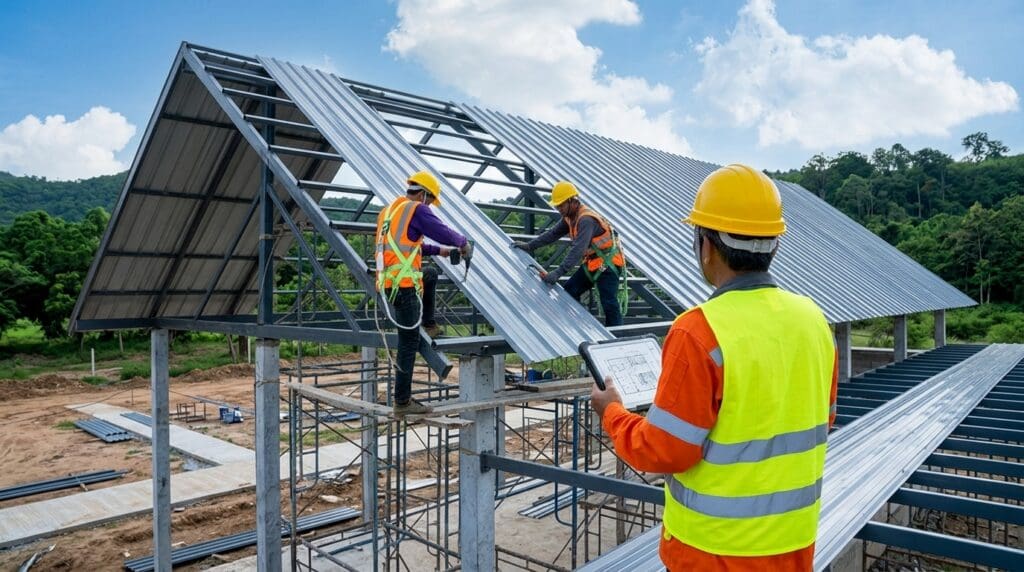
Physically walk the site and record what you see rather than what you remember from last time. Construction hazards cluster in predictable categories: working at height and fall risks, trenching and excavation collapse, electrical contact and overhead power lines, moving plant and vehicle strikes, falling objects, hazardous materials and dust, noise, and manual handling. Inspect the tools in use, the layout, the weather exposure, and the sequence of trades. Hazards frequently hide in plain sight, so a slow deliberate walk beats a quick glance from the site office.
Map who is exposed to each hazard
For every hazard, name who could be harmed and how. On a construction site that list runs wider than your direct crew, because subcontractors, delivery drivers, inspectors, visitors, and members of the public near the perimeter all move through the risk. A trench that is safe for a trained laborer can be deadly for a delivery driver who does not know it is there. Identifying the exposed groups shapes the control you choose, since protecting a trained worker and protecting an unaware passerby call for different measures.
Step Three and Four: Evaluate Risks and Apply Controls
Once you know what can go wrong and who it can hurt, you decide how serious each risk is and what to do about it. This is where judgment turns a list of hazards into an action plan.
Here’s how to rank and control what you found:
Score each risk by likelihood and severity
Evaluate each hazard by how likely it is to cause harm and how serious that harm would be. A simple likelihood-times-severity matrix lets you separate the risks that demand immediate action from the ones you monitor. This ranking keeps you from spending your whole budget on a rare low-impact hazard while a likely serious one goes unaddressed. Prioritizing honestly is what makes the assessment a decision tool rather than a wish list.
Use the hierarchy of controls
Apply controls in the order of effectiveness known as the hierarchy of controls: eliminate the hazard first, then substitute something safer, then engineer a control, then use administrative measures, and rely on PPE last. A guardrail that removes a fall risk protects better than a harness that depends on a worker clipping in correctly every time. Working top-down through the hierarchy produces stronger protection than defaulting to hard hats and hoping, and it demonstrates the kind of diligence regulators and insurers expect.
Step Five: Record Findings and Review Regularly
An assessment that lives only in your head protects no one and proves nothing. The final step turns your work into a record and keeps that record alive as the site evolves.
Here’s what documentation and review require:
Document your significant findings
Write down the significant hazards, who is at risk, the controls you put in place, and who is responsible for each. Dated written records show that the assessment happened and give the crew a reference they can actually follow. On a construction site this document also becomes the backbone of your toolbox talks and site inductions, so clarity matters more than length. If an incident ever leads to a claim or an inspection, this record is the first thing anyone asks to see.
Reassess when the site changes
A construction site risk assessment is never finished, because the site itself never stops changing. Reassess when a new phase begins, when new equipment or subcontractors arrive, after any incident or near-miss, and whenever the layout shifts. Early project phases carry their own spike in risk as large quantities of material and equipment get staged on-site. Treating the assessment as a living document rather than a one-time filing is what keeps it accurate as the build moves from foundation to finish.
The Step Most Checklists Miss: Security Risk
Every framework above focuses on keeping people safe from physical harm, and it should. What it leaves out is the risk that empties your budget rather than sends someone to the hospital, which is theft, trespass, and vandalism. On a construction site those threats are not a footnote.
Here’s why security belongs in the same assessment:
Construction theft is a measurable, expensive exposure
Construction site theft costs the US industry an estimated $300 million to $1 billion each year, and recovery rates for stolen equipment sit painfully low, often around 15 to 25 percent. Thieves target the same things every site stages out in the open: copper wiring, power tools, and portable equipment, with copper prices near record highs driving organized crews. Florida is a repeat hotspot, with one county alone reporting $2.4 million in stolen power tools in a single year, according to reporting on construction site theft trends. Theft concentrates at night, on weekends, and during long holidays when nobody is watching.
Assess your site for security gaps too
Run the same five-step logic on the security side. Identify the exposures (unsecured perimeter, poor lighting, staged high-value materials, uncontrolled access points), decide what is at risk, evaluate likelihood and impact, and apply controls. Those controls often include perimeter fencing, lighting, access logging, and a physical security presence during the highest-risk hours. Professional construction site security services close the gap that a safety-only assessment leaves wide open, and on a site with six figures of exposed equipment, the math favors coverage over replacement.
Protect the Whole Site, Not Just Your People
A strong construction site risk assessment does two jobs at once. It keeps your crew safe from physical harm, and it keeps your budget safe from theft and trespass. The five-step process handles the first, and adding a security review handles the second.
Almond Tree Security Services protects construction sites across Miami-Dade, Broward, and Monroe County, with licensed officers, perimeter coverage, and patrols timed to the hours when theft actually happens. If you want a clear read on where your site is exposed, take a look at our construction site security services and reach out whenever you would like to talk it through. No pressure either way.
Frequently Asked Questions
What are the five steps of a construction site risk assessment?
The five steps are: identify hazards, determine who might be harmed and how, evaluate the risk and decide on precautions, record your significant findings, and review and update the assessment regularly. This framework is recognized by OSHA and international safety guidance and applies to sites of any size.
Who is responsible for conducting a construction site risk assessment?
The employer or the party controlling the site holds legal responsibility for the assessment. The actual work is often carried out by a competent person, such as a site manager or safety officer with the training to identify hazards and the authority to correct them. Responsibility for the outcome cannot be delegated away.
How often should a construction site risk assessment be updated?
Update the assessment whenever conditions change. That includes the start of a new project phase, the arrival of new equipment or subcontractors, changes to the site layout, and any time an incident or near-miss occurs. Many sites also review assessments on a set schedule as a minimum baseline.
Does a construction risk assessment need to include security?
A complete assessment should. Standard safety assessments cover physical hazards to workers, but they rarely address theft, trespass, and vandalism, which cause major financial loss on construction sites. Adding a security review of the perimeter, access points, lighting, and high-value materials gives you a fuller picture of total site risk.
What is the hierarchy of controls?
The hierarchy of controls ranks protective measures from most to least effective: elimination, substitution, engineering controls, administrative controls, and personal protective equipment. Applying controls in this order produces stronger protection than relying on PPE alone, because it addresses hazards at their source before depending on worker behavior.