

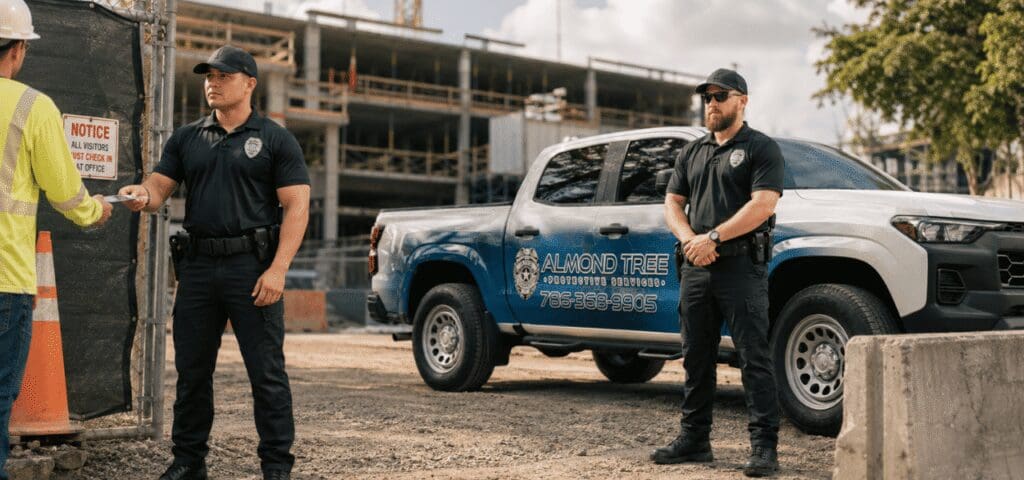
Securing a construction site is not one job. For a general contractor, project manager, superintendent, or developer, it is three jobs happening at the same time: control who and what can leave the site, stop unauthorized people from getting in, and meet the contractual, insurance, fire-safety, and—in Florida—hurricane requirements that apply to the project.
That last part has become more important in Florida. Since 2025, state law has imposed specific hurricane-preparedness requirements on certain cranes and hoisting equipment, including a 24-hour deadline before anticipated hurricane impacts.
A good construction site security plan therefore cannot end with “install a fence and cameras.” It needs layers: perimeter control, managed access, hardened assets, documented inventory, and a response plan for when something actually happens.
How Do You Secure a Construction Site?
To secure a construction site, use five overlapping layers: establish a controlled and well-lit perimeter, restrict vehicle and personnel access, immobilize and lock high-value equipment and materials, document assets before a loss occurs, and use monitored detection with a defined response procedure. In Florida, the plan should also address hurricane preparation, including the requirements of Florida Statute 489.1132 when covered cranes or hoisting equipment are on site.
First – Who Is Actually Responsible for Construction Site Security?
Start with the contract.
Responsibility for stolen materials, damaged equipment, and site protection does not automatically sit with the same party on every project. The contract documents, subcontract agreements, insurance arrangements, ownership of equipment, and provisions dealing with risk of loss should establish who carries each exposure.
In practice, the general contractor often controls day-to-day site security because the GC controls the site. But an owner, subcontractor, equipment lessor, or supplier may retain responsibility for specific property.
Builders risk insurance is another reason not to treat security as an informal field decision. Builders risk policies commonly cover theft among other causes of loss, while insurers publish risk-control recommendations covering fencing, access control, lighting, inventory records, locked storage, surveillance, and security personnel. Travelers, for example, recommends developing a crime/theft prevention plan using multiple layers rather than relying on one control.
A correction worth making: OSHA does not require general theft-prevention security
OSHA is frequently brought into jobsite-security discussions, but its construction standards primarily regulate worker safety and specific workplace hazards.
OSHA does require measures such as fire-protection programs, safe material storage, excavation protection, crane safety, and fire watches under certain hot-work conditions. What OSHA does not contain is a general rule saying every construction project must provide guards, theft-prevention cameras, or a particular anti-theft security system.
Do not confuse OSHA compliance with property-security planning.
Florida’s new crane requirement is different. Florida Statute 489.1132 specifically places hurricane-related duties on the project’s “controlling entity,” defined as the general contractor, prime contractor, or construction manager with overall responsibility for the project.
The Five Layers of a Secure Job Site
The important word here is layers.
A six-foot fence does little if everybody has a gate key. A perfect camera image does little if nobody sees the alert until morning. GPS helps recover a machine but does not stop a trailer from leaving the gate. A guard cannot compensate for equipment keys left in cabs across a 20-acre site.
Each layer should make the next layer harder to reach.
Layer 1 – Build a Perimeter That Controls Movement
The perimeter establishes where public space ends and controlled space begins.
Use continuous temporary or permanent fencing appropriate to the site, with lockable gates and as few active entry points as operations allow. Great American Insurance recommends fencing, regular perimeter inspections, warning signs, lighting, and—where practical—limiting a project to one controlled access point.
Gate placement matters as much as fence height. A gate behind a trailer, dumpster, landscaping barrier, or poorly aimed light can create exactly the blind spot a fence was supposed to remove.
Lighting should support both deterrence and observation. Prioritize entrances, material staging areas, site trailers, fuel storage, equipment parking, pedestrian approaches, and stretches of perimeter where natural surveillance is limited.
There is also a trade-off with privacy screening.
Opaque screening can reduce public visibility of valuable material, but it can also prevent nearby patrol units, neighboring businesses, or law enforcement from seeing activity inside the fence. Treat screening as a site-specific decision rather than automatically wrapping every fence line.
Finally, post clear no-trespassing and restricted-access signage. Signs will not stop a determined offender, but they clarify the boundary and support the larger access-control system.
Layer 2 – Control Access, Not Just the Gate
A construction site can have an excellent perimeter and still lose material through an authorized entrance.
The objective is not merely to stop strangers. It is to know who entered, why they entered, what vehicle they brought in, and what should be leaving with them.
For an active commercial site, that normally means:
- one primary controlled entrance where practical;
- employee and subcontractor identification;
- visitor and vendor sign-in;
- current subcontractor and delivery lists;
- procedures for temporary labor;
- delivery appointments when a responsible person is available to receive materials;
- controlled gate credentials rather than widely shared codes; and
- a process for verifying unusual outbound loads.
Great American’s 2026 construction theft guidance specifically recommends controlling access points, scheduling deliveries so materials can be secured promptly, and making subcontractors follow the site’s risk-management plan.
That matters because theft does not always look like a nighttime fence breach.
A pickup leaving at 2 p.m. with conduit, tools, fixtures, or scrap in the bed may attract less attention than somebody climbing a fence at 2 a.m. The person driving it may be wearing a vest, hard hat, and boots just like everybody else on the project.
Your access process has to work when the person looks as if they belong there.
Layer 3 – Harden the Assets
Once somebody reaches the equipment or material, make moving it difficult.
Heavy equipment should be immobilized when practical, with ignition and key control treated as a security procedure rather than an end-of-shift habit. Great American recommends removing keys, disabling heavy equipment, using fuel cutoffs or hydraulic bypasses, installing GPS on higher-value machines, locking fuel caps, and keeping equipment in secure, well-lit areas.
Key discipline deserves particular attention. Do not leave equipment keys in cabs, in an unlocked foreman’s desk, or hanging on a universally understood board inside the trailer. Limit access and know who has each key or credential.
For smaller assets:
- lock tools in properly secured gang boxes or containers;
- anchor boxes where feasible;
- consolidate high-value material instead of scattering it across the project;
- control fuel access;
- move easily resold material out of public sight;
- avoid staging expensive fixtures long before installation; and
- schedule just-in-time deliveries when the construction schedule allows.
Travelers specifically recommends just-in-time delivery where practical because materials delivered before a structure is secure become easier theft targets.
Copper and wire deserve their own staging decision. Do not leave large quantities distributed through open floors or partially completed runs when they can be consolidated into a controlled zone until installation.
The point is simple: make stealing something require time, tools, noise, knowledge, or multiple people.
Layer 4 – Document the Site Before Something Goes Missing
Many contractors begin documenting equipment after the theft.
That is too late.
Create an asset register for high-value equipment and maintain:
- make and model;
- serial number or Product Identification Number;
- company asset number;
- clear photographs;
- distinguishing marks;
- current site location;
- responsible subcontractor or department; and
- GPS or telematics identifier where fitted.
This is not administrative busywork. Recovery rates for stolen equipment have historically been poor.
NICB and National Equipment Register data recorded 11,625 heavy-equipment thefts in 2014, including 915 in Florida, making Florida the third-highest state that year. Only 23% of the equipment reported stolen in that 2014 dataset was recovered. The year matters: these are 2014 figures, not 2026 figures.
Later NER/NICB data from 2016 put the recovery rate at roughly 21%. Again, that is older national data, but it demonstrates why identification before the loss matters.
Contractors can also register equipment information through the National Equipment Register’s HELPtech system, including make, model, year, PIN, owner-applied numbers, and component serial numbers.
Your inventory should not stop at machines. Photograph and log expensive generators, specialty tools, copper inventories, switchgear, appliances, HVAC equipment, and other assets whose disappearance could stop the schedule.
Layer 5 – Detection Needs a Response
Cameras are useful. So are alarms, motion analytics, remote monitoring, GPS geofences, and temporary surveillance towers.
But each answers a different question.
A camera can tell you what happened.
A monitored camera may tell you what is happening.
A GPS unit may tell you where a stolen machine went.
An alarm may tell you a protected zone has been breached.
None of those answers the next question automatically:
Who is responding?
Write that part into the construction site security plan.
If a camera detects movement at 2:17 a.m., does a monitoring center verify it? Does someone call the superintendent? Is a mobile patrol dispatched? Is law enforcement contacted? Who has authority to open the site? Who preserves video? Who creates the incident report?
Without a response protocol, technology can become little more than excellent evidence of a loss.
Travelers’ risk-control guidance reflects the same layered approach: barriers, monitored electronic surveillance, materials management, and qualified security personnel where the site’s risk and values warrant it.
For projects that need an on-site response layer, Almond Tree’s construction site security services in Miami can be linked here rather than duplicating the guard-service discussion in this guide.
For lower-risk sites where a standing post is unnecessary, mobile security patrols can also be incorporated into an after-hours plan.
The Florida Layer: Securing a Construction Site Before a Hurricane
Florida contractors now have a security issue that most national construction-site guides never address.
SB 180 was approved by Governor Ron DeSantis on June 26, 2025 and became Chapter 2025-190 on June 30. The law created Section 489.1132.
For a worksite with a tower crane or covered mobile crane, a hurricane preparedness plan for the crane must be available for inspection at the site.
The statute defines the “controlling entity” as the general contractor, prime contractor, or construction manager with overall responsibility for the construction project.
Most importantly, the controlling entity must ensure covered hoisting equipment is secured no later than 24 hours before hurricane impacts are anticipated to begin.
The statute includes requirements such as:
- following manufacturer recommendations for hurricane and high-wind events;
- lubricating tower-crane turntables;
- laying down fixed booms on mobile cranes when feasible;
- retracting and storing hydraulic crane booms;
- locking hoist counterweights below the top tie-in;
- setting tower cranes in the weathervane position;
- removing rigging from hoist blocks; and
- disconnecting power at the base of tower cranes.
The mobile-crane definition also contains exclusions for equipment with a boom shorter than 25 feet or a maximum rated load capacity below 15,000 pounds, so contractors should verify whether a particular crane falls within the statutory definition rather than relying on a jobsite nickname for the machine.
Why Florida finally created the rule
The history is worth understanding.
Miami-Dade adopted Ordinance 08-34 in 2008, which included crane and hurricane-preparedness provisions. Significant portions were soon enjoined following a federal preemption challenge. Then, in 2012, Florida expressly preempted local regulation of hoisting equipment—including local regulation concerning hurricane preparedness to the state.
Hurricane Irma demonstrated the practical problem in 2017.
OSHA later investigated the failure of three hammerhead tower cranes—two in Miami and one in Fort Lauderdale—during Irma’s winds. The investigation found that all three were the same SK-315 model.
When Hurricane Dorian threatened Florida in 2019, the state temporarily waived the preemption so local governments could direct the securing of cranes.
Then Hurricane Milton hit St. Petersburg in October 2024. A Florida Building Commission research report notes that contractors had been asked, rather than legally ordered, to lower or deconstruct cranes because local building officials lacked legal authority over crane operation during incoming wind events. One tower crane at 400 Central later collapsed during the storm.
The 2025 statute finally created a statewide rule.
And the work is still developing: in June 2026, the Florida Building Commission reviewed a draft report on best practices for hurricane-season use of tower cranes and hoisting equipment. Under the statute, the Commission must report its findings to the Legislature by December 31, 2026.
Do not stop at the crane
The statute is only the legal minimum for the equipment it covers.
A hurricane plan should also address loose lumber, fencing panels, dumpsters, temporary signage, scaffolding components, portable toilets, unsecured sheet material, small equipment, fuel, trailers, temporary power, and anything else that could become windborne debris or obstruct emergency access.
The 24-hour statutory deadline should therefore be the end of crane preparation—not the beginning of whole-site hurricane planning.
Fire Risk During Construction Is a Separate Security Problem
Theft is not the only after-hours exposure.
Buildings under construction can be particularly vulnerable to severe fire before permanent suppression and alarm systems are fully installed and operational. Travelers specifically identifies this period as a heightened property-loss exposure.
NFPA 241 is the standard for safeguarding construction, alteration, and demolition operations, covering temporary construction, storage, utilities, fire protection, hot work, and other site hazards.
OSHA also requires additional personnel to guard against fire during welding, cutting, or heating when normal fire-prevention precautions are insufficient.
For a deeper Florida-specific breakdown, link here to fire watch requirements in Miami-Dade and Almond Tree’s construction fire watch service rather than duplicating those requirements in this article.
What Does Construction Site Security Cost?
There is no responsible single-dollar answer without seeing the site.
The budget changes with:
- property size and layout;
- number of entrances;
- coverage hours;
- number of posts;
- standing officers versus patrol visits;
- armed versus unarmed staffing;
- monitoring requirements;
- project duration;
- surrounding crime exposure;
- value and mobility of equipment; and
- whether the site has just experienced an incident.
That is why security should be priced against loss exposure, not treated only as another general-conditions line item.
The National Equipment Register has historically estimated annual U.S. construction-equipment theft losses at between $300 million and $1 billion, excluding many losses involving tools and building materials.
A 2025 Construction Equipment Guide article citing NER data placed the average equipment-theft incident around $30,000, before productivity losses, replacement rentals, and schedule disruption.
You will also see a 1%–5% of project cost theft-impact estimate repeated throughout construction-security literature. Treat that as an industry planning estimate rather than a precise national benchmark; its source trail is considerably weaker than the NICB/NER theft counts and recovery data.
For many projects, the sensible question is therefore not, “Can we afford 24/7 security?”
It is:
Which hours, assets, and access points create enough exposure to justify additional protection?
A targeted overnight, weekend, shutdown, or delivery-period plan can cost materially less than continuous staffing while concentrating resources around identified risk.
Job Site Security Checklist
Use this checklist during mobilization, at major phase changes, before high-value deliveries, and before extended shutdowns.
Perimeter and access
☐ Maintain a continuous perimeter appropriate to the site’s exposure.
☐ Inspect fencing regularly for gaps, moved panels, cut sections, or easy climbing points.
☐ Reduce active gates to the minimum operations require.
☐ Keep entrances and critical perimeter areas illuminated after dark.
☐ Post clear restricted-access and no-trespassing signage.
☐ Maintain current lists of authorized employees, subcontractors, vendors, and deliveries.
☐ Control gate keys, access codes, badges, and credentials.
☐ Create a procedure for verifying unusual vehicles and outbound material.
Equipment and materials
☐ Remove equipment keys at the end of the shift and restrict access to them.
☐ Immobilize or electronically disable high-value machines where practical.
☐ Use GPS or telematics on priority assets.
☐ Lock tools in secured gang boxes, containers, or buildings.
☐ Consolidate copper, wire, fixtures, and other high-value material into controlled storage.
☐ Schedule major deliveries when somebody is available to receive and secure them.
Documentation and response
☐ Record serial numbers, PINs, photographs, and identifying marks before equipment arrives on site.
☐ Maintain an updated site asset inventory.
☐ Register applicable equipment information with the National Equipment Register.
☐ Test cameras, alarms, lighting, monitoring, and communication systems regularly.
☐ Write down exactly who receives an alarm and who responds after hours.
☐ Review the security plan whenever the project layout or risk profile changes.
Florida hurricane readiness
☐ Maintain the required crane hurricane preparedness plan where FS 489.1132 applies.
☐ Identify the project’s controlling entity for statutory compliance.
☐ Start hurricane preparation early enough to meet the 24-hour securing deadline.
☐ Follow manufacturer high-wind recommendations for covered hoisting equipment.
☐ Remove or secure loose materials and temporary equipment that could become windborne debris.
Frequently Asked Questions
How do you secure a construction site at night?
Secure the perimeter and gates, illuminate access and high-value areas, remove equipment keys, lock tools and valuable materials, activate cameras and alarms, and define who responds when an alert occurs. Sites with higher loss exposure can add scheduled mobile patrols or licensed officers during non-working hours.
Who is responsible for security on a construction site?
The contract and risk-of-loss provisions determine responsibility for property and materials, so there is no universal answer for every project. The general contractor often controls day-to-day site security. Separately, Florida Statute 489.1132 makes the “controlling entity”—the general contractor, prime contractor, or construction manager with overall project responsibility—responsible for its hurricane-related hoisting-equipment requirements.
Does OSHA require construction site security?
OSHA regulates construction safety and specific hazards, but there is no general OSHA requirement that every construction site employ theft-prevention guards, cameras, or a particular anti-theft system. OSHA does impose requirements relating to issues such as fire prevention, excavations, equipment, cranes, material storage, and worker safety.
How do I secure a construction site before a hurricane in Florida?
Begin before a watch or warning leaves you with insufficient time. Secure loose materials and temporary equipment, protect openings and access points, preserve emergency routes, back up site records, and follow manufacturer requirements for major equipment. If Florida Statute 489.1132 applies, covered hoisting equipment must be secured no later than 24 hours before anticipated hurricane impacts, and a hurricane preparedness plan for a covered tower or mobile crane must be available for inspection at the worksite.
What is the most stolen item from construction sites?
There is no sufficiently current national dataset that supports naming one item as the universal “most stolen” construction-site asset in 2026. In NICB/NER’s 2014 heavy-equipment dataset, riding mowers were first overall, followed by wheeled loaders and tractors—but that dataset covers heavy equipment broadly and should not be presented as a current construction-only ranking. Insurer loss-control guidance continues to identify copper, tools, generators, plumbing supplies, loaders, backhoes, and similar portable or readily resold assets as common targets.
Do security cameras stop construction site theft?
They can deter activity, detect intrusion, document events, and support investigations, but a camera alone does not guarantee intervention. The stronger setup connects surveillance to active monitoring, an alarm procedure, site management, mobile patrol, on-site personnel, or law enforcement response as appropriate.
How much does construction site security cost in Florida?
Pricing depends primarily on site size, coverage hours, officer count, armed versus unarmed staffing, patrol frequency, location, and risk. A site assessment is more useful than a generic hourly figure because a small gated project needing overnight patrols has a very different exposure from a multi-acre development requiring controlled entrances and continuous posts.
Working With Almond Tree Security
A construction site security plan should start with the site, not with a staffing package.
Almond Tree Security Services is a Homestead-based, licensed and insured security agency serving Miami-Dade, Broward, and Monroe counties under Florida Security Agency License B 3500420. The company provides armed and unarmed officers, gate control, after-hours protection, patrol coverage, and incident reporting for active construction projects. Almond Tree responds to service inquiries within 2 hours and can deploy licensed officers within 4 hours across its South Florida service area.
If you are reviewing an existing project after a theft, preparing for a shutdown, or deciding whether cameras, patrols, or an on-site officer make sense, start with a site assessment.
View our construction site security services in Miami to see available coverage options, or request a construction site security assessment for a recommendation based on your actual site layout, schedule, and exposure.
This article provides general construction-site security and Florida compliance information and is not legal, insurance, engineering, or hurricane-preparedness advice. Contractors should verify current requirements with their attorney, insurer, engineer, equipment manufacturer, local Authority Having Jurisdiction, and applicable Florida agencies.