
Florida law requires at least two people to be on the premises at all times where cannabis is cultivated, processed or stored. Section 381.986, Florida Statutes, allows those two to be the licensee’s own employees or two employees of a security agency it contracts with. On top of that staffing rule, the facility must run a full alarm system and continuous video surveillance.
Most coverage of this topic is written by camera companies. The staffing requirement is the part that gets skipped, and it is the one with the largest operating cost attached.
Does Florida require security guards at a cannabis grow facility?
Yes, in effect. The statute does not use the word “guard,” but it requires two people present at all times where cultivation, processing or storage happens, and it names a contracted security agency as one acceptable way to meet that.
This is a staffing obligation, not an equipment one. Cameras and alarms are separate requirements that sit alongside it. A facility can have a flawless surveillance install and still be out of compliance if the two-person coverage lapses at 3 a.m. on a Sunday.
Only licensed Medical Marijuana Treatment Centers may cultivate cannabis in Florida, and MMTCs are vertically integrated, meaning the same licence covers growing, processing and dispensing. Each stage requires its own authorisation from the Office of Medical Marijuana Use. Cultivation authorisation comes first, and readiness is assessed before it is granted rather than after.
What “at all times” means for your staffing plan
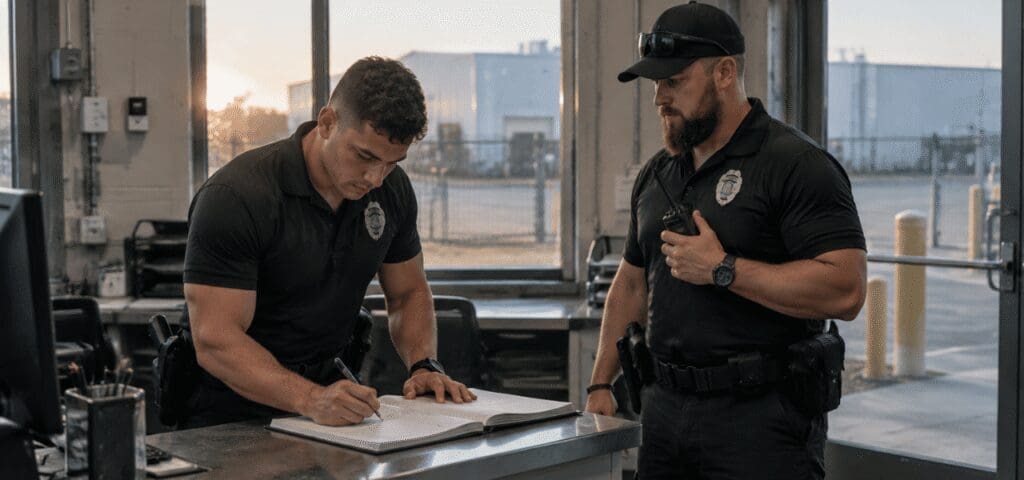
Two people, continuously, works out to more roster than most operators expect.
Here is the arithmetic. One post covered around the clock is 168 hours a week. A full-time officer works 40. That means roughly 4.2 officers to keep a single post filled with nobody working overtime. Two posts doubles it to about 8.4, and that number is before holidays, sick days, training days and turnover.
In practice a compliant two-person, 24-hour post needs somewhere in the region of nine to ten people on the roster.
| Coverage | Hours per week | Minimum officers |
|---|---|---|
| One post, 24/7 | 168 | ~4.2 |
| Two posts, 24/7 | 336 | ~8.4 |
| Two posts, 24/7, with relief | 336 | 9 to 10 |
That is the number that decides whether you staff this internally or contract it. Nobody publishes it, so it usually surfaces halfway through the first quarter of operation, when the schedule starts breaking.
What the alarm and camera requirements cover
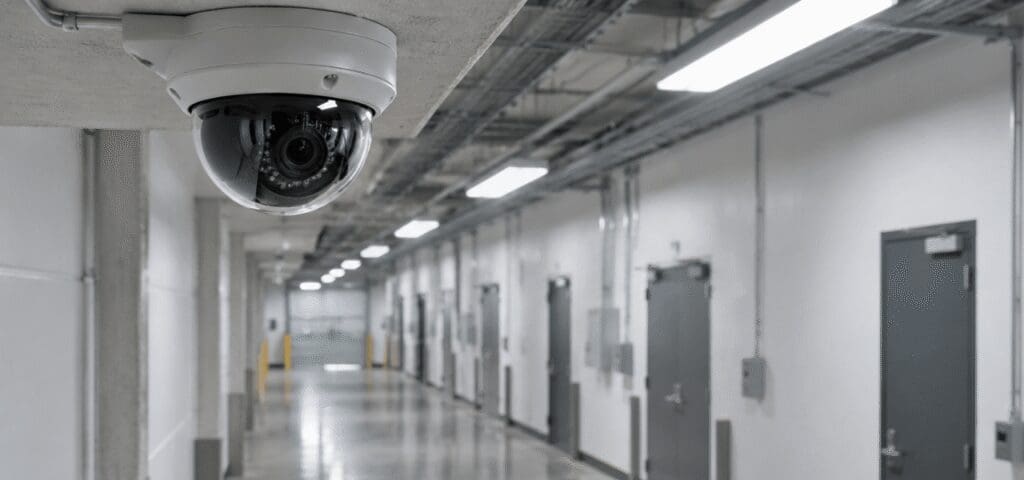
The statute is specific about both systems, which is unusual.
The alarm system must be fully operational and secure all entry points and perimeter windows. It must include motion detectors, pressure switches, and duress, panic and hold-up alarms. Duress and panic alarms are the ones most often missed, because they are about people rather than the building.
The video system must record continuously, 24 hours a day, with cameras fixed in positions that allow clear identification of persons and activities in controlled areas.
Controlled areas are defined, and the list is broader than people assume:
- Grow rooms
- Processing rooms
- Storage rooms
- Disposal rooms and disposal areas
- Point-of-sale rooms
Disposal areas catch operators out. Waste is where diversion is easiest and where coverage is thinnest, because it is often outdoors or in a back corridor that nobody thought of as a controlled area.
Retention periods are set by Office of Medical Marijuana Use rule rather than by the statute, and they have moved. Confirm the current requirement with OMMU before you specify storage, rather than working from a figure in an article.
Badges, visitors and the drug-free workplace rule
Three further requirements sit in the same section and are cheap to comply with, which is exactly why they get forgotten.
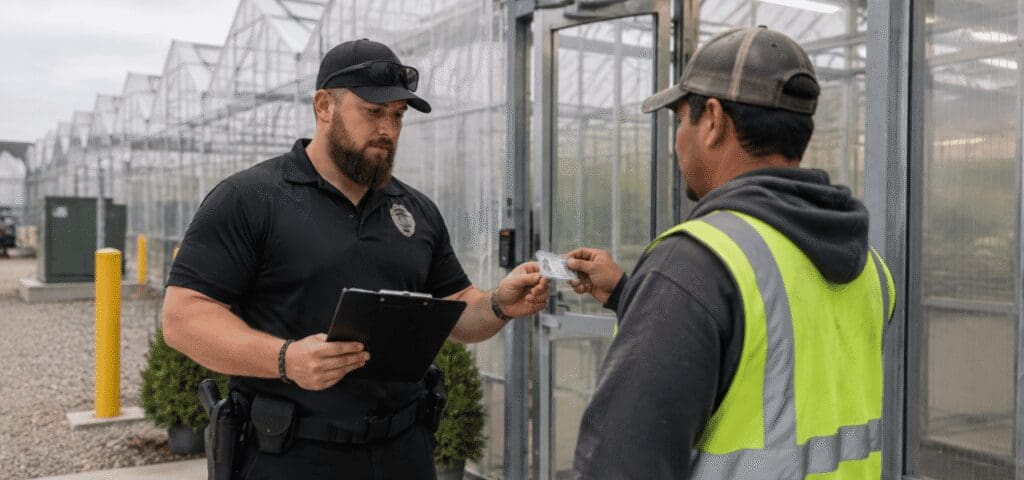
Every employee and every contractor must wear a photo identification badge at all times on the premises. That includes contracted security officers, so the badge system has to extend to people who are not on your payroll.
Every visitor must wear a visitor pass. And the facility must operate an alcohol and drug-free workplace policy.
None of this is difficult. It fails on the day a maintenance crew arrives at 6 a.m. and nobody at the door has a pass to give them.
Reporting theft, diversion or loss within 24 hours
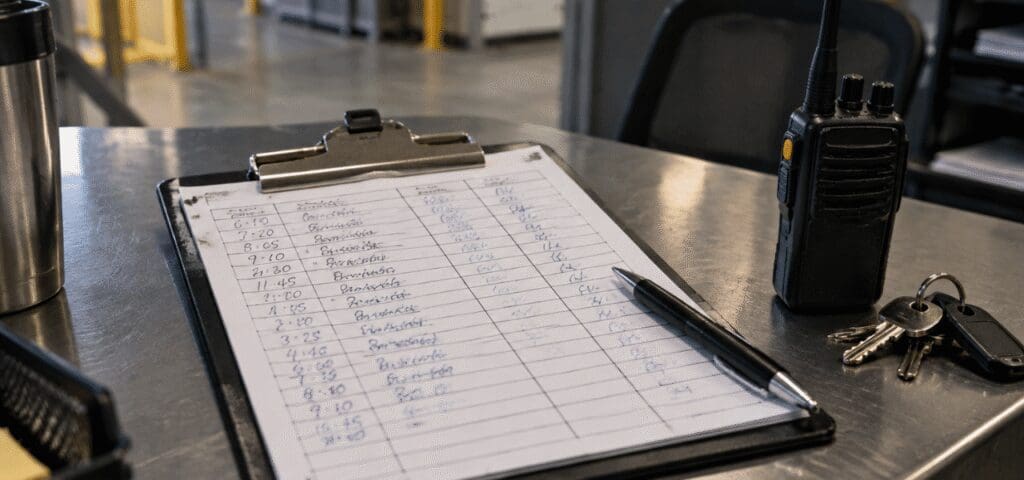
An MMTC must report theft, diversion or loss of marijuana to local law enforcement within 24 hours of learning about it.
The clock starts when the licensee becomes aware, not when the loss occurred. That distinction puts weight on the inventory count and the shift log, because those documents are what establish when awareness began.
This is also where a security post earns its cost. An officer who logs an anomaly at the time it happens gives you a defensible timeline. A discrepancy discovered three weeks later during a reconciliation does not.
How grow facility security differs from a dispensary
Same statute, different risk shape.
| Grow and processing facility | Dispensary | |
|---|---|---|
| Two-person requirement | Applies whenever cultivation, processing or storage occurs | Applies where storage occurs |
| Main exposure | Diversion by insiders, high-value plant inventory | Cash on premises, public access |
| Public access | None | Continuous during opening hours |
| Controlled areas | Grow, processing, storage, disposal | Storage, point of sale, disposal |
| Typical coverage pattern | Continuous, including overnight | Concentrated on opening hours |
The retail side is covered in our guide to Florida dispensary security requirements.
The difference that matters operationally: a dispensary’s risk peaks when the public is inside, and a cultivation site’s risk peaks when nobody is. Overnight is the expensive shift and the one that gets cut first when budgets tighten.
When your own staff can cover the two-person requirement
The statute lets you use your own employees, and for some operators that is the better answer.
If your facility already runs continuous production shifts with two or more people present, you may already satisfy the requirement without hiring anyone. A cultivation site with overnight climate and irrigation staff is the clearest case.
Where it breaks down is coverage gaps and evidence. Production staff take breaks together, shifts change, and a person doing a job is not a person watching a door. If the second person on site during a shift change is in a grow room at the other end of the building, the requirement is arguably not being met, and a shift log written by production staff is unlikely to hold up as security documentation.
The honest test: look at your roster for a single week and mark every fifteen-minute block where fewer than two people were verifiably on the premises. If there are none, you may not need a security agency for the staffing rule at all. If there are several, that is the gap a contracted post fills.
Cannabis facility security in South Florida
Almond Tree Security Services is a Homestead-based Florida-licensed security agency holding Security Agency Licence B 3500420 and Private Investigation Agency Licence A 3500419, serving Miami-Dade, Broward and Monroe counties.
Officers hold Florida Class D licences, and Class G where an armed post is required, and complete 40 hours of field training before their first assignment. We respond to every request within 2 hours and can have licensed officers on site within 4.
See our full cannabis security services, including site posts and transport coverage, or call (786) 368-9905.
Frequently asked questions
Does Florida law require armed guards at a cannabis grow facility?
No. The statute requires two people on the premises at all times where cultivation, processing or storage occurs, but it does not specify armed officers. Armed coverage is a risk decision, driven by cash on site, location and insurer requirements, and armed officers must hold a Florida Class G licence in addition to Class D.
Can one officer cover a cannabis cultivation site?
No. The requirement is two people present at all times where cultivation, processing or storage happens. A single officer does not satisfy it, regardless of how the site is laid out or how much camera coverage is installed.
Do contracted security officers need badges?
Yes. Florida law requires every employee and every contractor to wear a photo identification badge at all times on the premises. Contracted security officers fall under that, so your badge process has to cover people who are not on your payroll.
How long does a cannabis facility have to keep video footage in Florida?
Retention is set by Office of Medical Marijuana Use rule rather than by the statute itself, and it has changed over time. Check the current OMMU requirement directly before specifying storage capacity, because designing to an outdated figure is a common and expensive error.
Can anyone other than an MMTC grow cannabis in Florida?
No. Only licensed Medical Marijuana Treatment Centers may cultivate cannabis in the state, and the licence is vertically integrated across cultivation, processing and dispensing. Cultivation outside that framework is a criminal offence, not a licensing matter.
How much does a two-person 24-hour security post cost?
It is priced per officer per hour, and continuous coverage is quoted at a lower blended rate than short-term work because the fixed costs spread across the month. The variables are armed or unarmed, the number of separate posts, and whether the site needs coverage at shift changes only or around the clock.