
The sprinkler contractor shut our riser down at nine in the morning, and by noon I had a fire marshal on the phone asking who was standing fire watch. I told him we had a security guard on-site, the same one who worked our lobby every day, and I could hear the pause. He explained, patiently, that my lobby guard checking the door was not a fire watch, that the two were different jobs with different rules, and that if I did not get compliant coverage in place the building might have to clear out. I had assumed a guard was a guard. That afternoon cost me a scramble, a premium rate for last-minute coverage, and a lesson I have never forgotten. The uniform looks the same. The obligation behind it is not.
If you manage a property and you are trying to sort out fire watch vs security guard coverage, whether you need one, the other, or both, this guide breaks down exactly what separates the two roles, what a fire watch legally requires in Florida, and how to know which one your situation calls for.
The Core Difference Between a Fire Watch and a Security Guard
The two roles get confused because the same licensed officer can perform either one, but they answer to entirely different purposes and rulebooks. Understanding that split is what keeps a property compliant and safe.
Here’s what actually separates the two jobs:
What a security guard does
A security guard protects a property and the people on it from human threats. Their work centers on deterring theft, preventing unauthorized access, patrolling grounds, monitoring entry points, controlling occupancy, and responding to suspicious or disruptive behavior. A guard is a physical security asset whose value lies in presence, observation, and the ability to intervene when something or someone poses a risk. The role is broad and ongoing, tied to the property’s general security needs rather than to any single hazard or event.
What a fire watch does
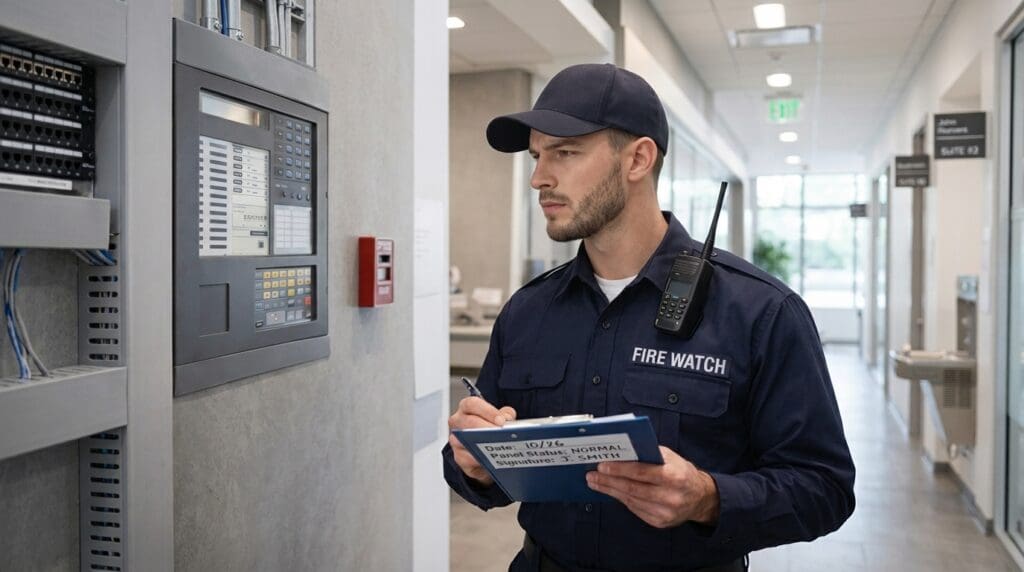
A fire watch is a narrowly defined fire-safety function, not a general security role. A fire watch officer is assigned to continuously patrol a specific area to detect fire, smoke, and ignition hazards while a building’s fire protection is compromised or a fire-prone activity is underway. Their entire job is early detection and immediate notification, which means walking a defined route at set intervals, watching for hazards, keeping a time-stamped log, and calling the fire department the instant something develops. It is a temporary, condition-driven assignment governed by fire code rather than by a security contract.
When Florida Law Requires a Fire Watch
A security guard is a choice a property owner makes. A fire watch is frequently a legal obligation the fire code imposes, and knowing the triggers keeps you from finding out the hard way. Florida enforces these rules through the Florida Fire Prevention Code, which adopts national fire standards.
Here’s what actually triggers a mandatory fire watch:
Impaired fire alarm or sprinkler systems
The most common trigger is an out-of-service fire protection system. Under the codes Florida adopts, if a required fire alarm system is out of service for more than four hours in a 24-hour period, the authority having jurisdiction must be notified, and the building must either be evacuated or placed under an approved fire watch. For water-based systems like sprinklers, the threshold extends to more than ten hours in a 24-hour period. A contractor draining a riser for repairs, an alarm panel showing a fault, or a renovation that damages a system all cross that line. Florida’s ongoing high-rise condominium sprinkler retrofit deadlines are generating a steady wave of exactly these impairment events across the state.
Hot work and construction sites
Hot work is the other frequent trigger. Any welding, cutting, grinding, or torch work that throws sparks requires a fire watch during the work and for a set period afterward, commonly at least 30 to 60 minutes, because smoldering fires can hide in wall cavities and adjacent spaces for far longer than the visible activity lasts. Construction and demolition sites carry their own fire watch requirements when the site’s fire prevention program calls for them. In every one of these cases, the local fire marshal, as the authority having jurisdiction, holds the final say and can order a watch, an evacuation, or a work stoppage.
Why a Regular Security Guard Cannot Simply Cover a Fire Watch
This is the trap that catches property managers, and it is the exact mistake I made with my lobby guard. A fire watch has legal requirements that a standard security post does not meet, and assuming otherwise creates a compliance failure the fire marshal will catch.
Here’s why the two roles cannot overlap in practice:
The no-other-duties rule
A fire watch must be the officer’s only responsibility during the watch. Fire codes and OSHA are explicit that a person conducting a fire watch cannot simultaneously perform other work, which means a guard cannot watch the lobby, receive packages, and patrol the impaired area all at once. A fire watch requires continuous patrol of the affected areas at defined intervals, and any competing duty breaks that continuity. A security guard assigned to a normal post who is also told to “keep an eye out for fire” does not satisfy the requirement, no matter how attentive they are.
Training, logs, and the credential difference
A compliant fire watch demands specific training that a general security assignment does not include. The officer has to recognize fire hazards, know the patrol route and intervals, understand the impairment they are covering, keep an accurate time-stamped log of every round, and know how to notify the fire department immediately. That written log is what the fire marshal asks for after the fact, and no log means no proof the watch happened. The same licensed officer can absolutely hold both capabilities, and many do, but they perform one role at a time. Choosing between armed and unarmed security officers is a separate decision from whether an officer is trained and assigned specifically to fire watch duty.
How to Know Which One You Need
Deciding between a fire watch, a security guard, or both comes down to what you are actually protecting against. Once you separate a human-threat problem from a fire-hazard problem, the answer usually becomes clear.
Here’s how to make the call:
Match the role to the risk
Ask what problem you are solving. If the concern is theft, trespass, access control, or crowd management, you need a security guard. If a fire protection system is offline, a hot work permit is active, or a fire marshal has ordered interim protection, you need a fire watch, and you need it staffed by someone trained and dedicated to that role alone. Many properties need both at once, such as a construction site that faces equipment theft and also runs hot work, and in that case the two functions are staffed as two separate assignments rather than folded into one.
Working with an agency that provides both
The cleanest solution is a security partner who staffs both roles with properly trained, licensed officers and understands Florida’s fire watch requirements. An agency that offers both can cover your general security while standing a compliant, well-documented fire watch when an impairment or hot work triggers one, keeping the paperwork the fire marshal expects. Almond Tree Security Services provides fire watch and security guard services across Miami-Dade, Broward, and Monroe County, so a single call covers whichever role your property actually needs.
Get the Right Coverage for Your Property
Fire watch and security guard work look similar from the outside, but they solve different problems and answer to different rules. A security guard protects against people. A fire watch protects against fire during the moments your systems cannot, and in Florida it is often the law rather than a choice. Knowing which one you need, and staffing it correctly, keeps your property safe and your fire marshal satisfied.
At Almond Tree Security Services we staff both roles with licensed, trained officers across Miami-Dade, Broward, and Monroe County, and we can tell you which your situation calls for. If you are facing a system impairment, a hot work permit, or just want to sort out your coverage, reach out whenever you like. No pressure either way.
Frequently Asked Questions
What is the difference between a fire watch and a security guard?
A security guard protects property and people from theft, trespass, and disorder as an ongoing role. A fire watch is a temporary, code-mandated safety function that requires a trained officer to continuously patrol for fire hazards while fire protection is impaired or during hot work. The fire watch officer can have no other duties during the watch.
Can a security guard also do fire watch duties in Florida?
Only if that officer is specifically trained for fire watch and assigned to it as their sole duty during the watch. Florida fire codes prohibit a person from performing security and fire watch duties simultaneously. The same licensed officer may hold both capabilities, but cannot carry out both roles at the same time.
When does Florida require a fire watch?
Florida requires a fire watch when a fire alarm system is out of service more than four hours in 24, when a sprinkler system is down more than ten hours in 24, during hot work like welding or cutting, on certain construction sites, or whenever the fire marshal orders one. The local authority having jurisdiction makes the final call.
What are the main fire watch duties?
Fire watch duties include continuously patrolling the affected and adjacent areas at set intervals, watching for fire, smoke, and ignition hazards, keeping clear exit routes, maintaining a time-stamped log of every round, and immediately notifying the fire department if a hazard develops. The officer must carry a communication device and have no competing responsibilities.
What happens if I do not provide a required fire watch?
If a required fire watch is not provided, the authority having jurisdiction can require the building to be evacuated, order work stopped, or close the space until the impaired system is restored. Missing or incomplete fire watch logs can also create compliance and insurance problems, since there is no proof the watch was conducted.