

The armed vs unarmed security guard question in Florida usually gets answered backwards. Most business owners start with a feeling, a break-in last month, a scary incident down the street, and work toward “we need armed guards.” Then they find out what it costs, and swing back the other way.
Neither instinct is a decision. Florida law draws a specific, narrow line between what an unarmed officer and an armed officer may do, and that line, not your budget or your gut, should drive the choice.
Here is what actually changes when a firearm enters the picture, based on Chapter 493 of the Florida Statutes rather than industry generalities.
The licence structure most buyers get wrong
Florida regulates private security through the Florida Department of Agriculture and Consumer Services (FDACS), Division of Licensing, under Chapter 493, Florida Statutes.
The most common misconception is that Class D and Class G are two alternative licences and a guard picks one.
They are not alternatives. Class G is an add-on. Under Section 493.6115(2), only certain licensees may bear a firearm at all, and any one of them who does must also hold a Class G Statewide Firearm Licence. For a security officer, that means holding a Class D and a Class G simultaneously. There is no such thing as an armed guard in Florida carrying a Class G alone.
What Class D requires
- Minimum age 18
- 40 hours of training at an FDACS-licensed security officer school
- Valid two years
- No annual requalification obligation
What Class G adds
- 28 hours of range and classroom firearms training, of which no more than eight hours may be in-person range time
- Age 21 or older to carry concealed in the course of duties
- Valid two years
- Four hours of requalification training every single year, taught by a Class K firearms instructor, specific to each type and calibre carried
That last line is the one that matters most to you as a client, and almost nobody explains why.
The compliance trap that puts your post at risk
Under Florida Administrative Code Rule 5N-1.132, a Class G licensee must complete four hours of requalification during each 12-month period of the two-year licence term, including the first year after the licence is issued.
Here is the trap. Completing the training is not enough. The officer must also report it to the Division of Licensing by the month and day shown as the expiry date on the licence.
An officer who completes the training on time but fails to submit proof within the reporting window has their Class G automatically suspended until proof is provided.
Read that again from your side of the contract. An armed officer standing on your property can be carrying a firearm on a suspended licence, not because he skipped training, but because paperwork sat in a folder. If an incident happens that night, your exposure is not theoretical.
The solution is contractual, and it is simple. Before you sign an armed contract, require the agency to:
- Provide the licence number and expiry date for every armed officer assigned to your site
- Provide dated proof of the most recent annual requalification for each officer
- Notify you in writing within 24 hours if any assigned officer’s licence status changes
- Re-verify at every contract renewal, not just at onboarding
Any agency that hesitates at those four points is telling you something.
What an armed officer can and cannot legally do
This is where a lot of buyers assume more authority than exists.
A firearm is tied to the assignment, not the person
Section 493.6115(3) provides that an employee may not carry a firearm unless the duties require it, and may not carry it except in connection with those duties. The same rule covers other weapons, which is why carrying pepper spray on duty also depends on the post, and the same goes for the stun guns covered in whether it is legal to carry a Taser in Florida. Section 493.6115(5) goes further: a Class G stays in effect only while the holder is employed in a qualifying licensed capacity. The moment that employment ends, so does the firearm authority.
Equipment is restricted by statute
Section 493.6115(6) limits Class G licensees to specific handguns, a .38 revolver, a .380 or 9mm semiautomatic, a .357 revolver firing .38 ammunition only, a .40 handgun, or a .45 ACP. No more than two firearms may be carried on the person while on duty, and the officer may only carry the specific type and calibre they qualified on.
That last point has a practical consequence: an officer qualified on a 9mm cannot simply be handed a .45 for a shift. The annual requalification is calibre-specific.
Detention authority is narrow
Section 493.631 allows a security officer to temporarily detain a person, but only at a defined critical infrastructure facility, only while on duty and in uniform, only with probable cause, and only where the officer holds a valid Class D (or MB) and a valid Class G. Law enforcement must be notified as soon as reasonably possible.
Outside those conditions, your officer is not a police officer and does not have police authority. Any agency implying otherwise is selling you a liability.
What Florida’s open carry ruling did, and did not, change
This one comes up constantly since 2025, and there is a lot of bad information circulating.
In September 2025, Florida’s First District Court of Appeal held in McDaniels v. State that the state’s open carry ban was unconstitutional, and the Attorney General declined to appeal. Open carry became lawful for ordinary law-abiding adults.
A reasonable business owner might conclude that firearms rules for security officers loosened too. They did not.
In an advisory opinion issued in October 2025, the Florida Attorney General addressed this directly: the ruling did not disturb the Class G licensing requirements for private investigators, security officers or recovery agents under Chapter 493. The decision dealt with the general open carry statute and ordinary citizens, not with the professional regulatory scheme.
Practical takeaway
Your armed officer still needs a Class G. Still needs annual requalification. Still limited to approved calibres. Nothing about the open carry change gives an agency a shortcut, and any agency suggesting it does is one you should walk away from.
When unarmed is genuinely the right answer
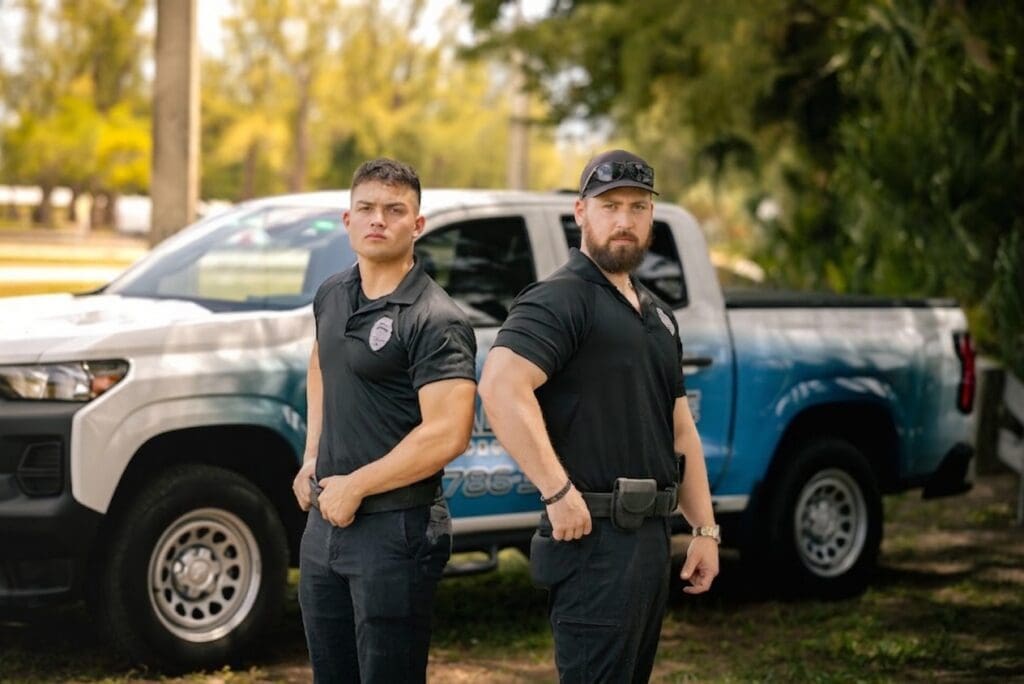
For most South Florida properties, it is, and not because it is cheaper.
Unarmed coverage is the right fit when your realistic risk profile is theft, vandalism, trespassing, loitering, access control, disputes between people, or documentation and response. That describes the majority of commercial and residential assignments.
Typical fits:
- Office buildings, retail and warehouses where the threat is property loss and after-hours access
- HOAs and residential communities where a visible presence and gate control do the work
- Most events where crowd management and de-escalation matter more than force
- Fire watch and compliance posts where the job is timed patrol and documentation
There is a reason beyond cost. An unarmed officer trained in observe-and-report and de-escalation is inherently less likely to create a situation that ends in a lawsuit. For properties where the primary goal is risk management, unarmed coverage is often the stronger risk decision, not the compromise.
When armed coverage is genuinely justified
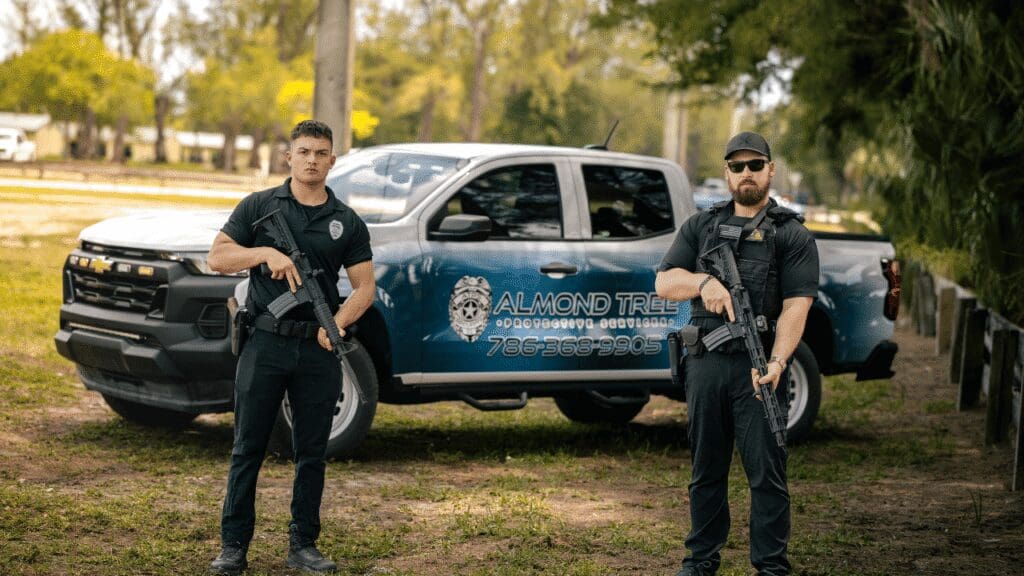
Armed makes sense when the realistic threat involves a person willing to use force, or where the asset itself invites planned, targeted crime.
Typical fits:
- Cannabis facilities and transport, high-value, cash-intensive, and a known target profile
- Cash-in-transit and high-value product movement
- Executive and VIP protection where a specific individual faces a specific threat
- Properties with a documented history of armed incidents, or where a credible threat has been made
- Assignments where your insurance carrier or a regulator requires it, check this before deciding, because it can settle the question outright
The test is not “would armed people feel safer?” It is: does the realistic threat involve a person willing to use force against a person? If the honest answer is no, armed coverage adds cost and liability without adding protection.
What actually drives the cost difference
Armed coverage costs more in South Florida, and it is worth understanding why rather than treating it as a markup.
The gap comes from real, recurring inputs:
- 28 hours of initial firearms training per officer
- Four hours of requalification every year, per calibre, per officer
- Firearms liability insurance, which sits on top of standard general liability
- A smaller pool of qualified officers, which raises wage pressure
- Higher administrative burden tracking licence and requalification status
Rates vary by county, shift timing, post duration and site risk, so any figure quoted without seeing your property is a guess. What you should insist on is a written breakdown showing what the armed premium buys, and if an agency’s armed rate is unusually low, ask specifically how they fund annual requalification for every assigned officer.
How to verify a guard’s licence before you sign
You do not have to take anyone’s word for this, and you should not.
FDACS Division of Licensing operates a public licence verification system. Search by name or licence number and you can see whether a licence is active, what class it is, and when it expires.
Do this before signing, and again at renewal:
- Verify the agency holds a current Class B Security Agency Licence, this is separate from any individual guard licence
- Verify each assigned officer’s Class D status and expiry
- For armed posts, verify Class G status separately, it is a different credential with its own expiry date
- Ask for dated proof of the most recent annual requalification for each armed officer
- Confirm the agency carries insurance appropriate to armed work, and read the indemnification clause in your service agreement
Point 3 catches the most people out. An officer can hold a perfectly valid Class D while their Class G sits suspended. Checking one does not check the other.
Choosing with Almond Tree Security
Almond Tree Security Services is a Homestead-based, Florida-licensed security agency, Security Agency Licence B 3500420, PI Agency Licence A 3500419, serving Miami-Dade, Broward and Monroe counties since 2017.
Every officer we field holds a Florida Class D licence and completes a 40-hour field training programme alongside an experienced officer. Officers on armed posts additionally hold a current Class G, and we track requalification dates internally rather than leaving it to the officer.
We are also comfortable telling a client they do not need armed coverage. Most of the time, they do not.
If you are weighing the two for a specific property, we will walk the site, tell you honestly which posts justify armed coverage and which do not, and quote both so you can compare.
Office: (786) 368-9905 Emergency: (305) 216-1818
See our security officer services or request a site assessment.
Frequently asked questions
What is the difference between a Class D and Class G licence in Florida?
A Class D Security Officer Licence authorises unarmed security work and requires 40 hours of training at an FDACS-licensed school. A Class G Statewide Firearm Licence is an add-on that authorises carrying a firearm during regulated duties, requiring 28 hours of range and classroom training plus four hours of requalification every year. An armed officer in Florida holds both.
Can a security guard carry a concealed weapon in Florida?
Under Section 493.6115(4), a Class D licensee who is 21 or older and also holds a Class G may carry a concealed firearm in the performance of their duties, subject to the conditions in Section 493.6305. Those conditions tie concealed carry to special assignments and plainclothes protection work, as explained in do security guards have to wear a uniform. The Class G licence must clearly indicate that authority. Otherwise the firearm is carried openly.
Can a security guard detain someone in Florida?
Only in narrow circumstances. Section 493.631 permits temporary detention at defined critical infrastructure facilities, where the officer is on duty, in uniform, holds both a valid Class D (or MB) and a valid Class G, and has probable cause. Law enforcement must be notified as soon as reasonably possible. Outside those conditions, a security officer has no special detention authority.
Does Florida’s open carry ruling change the rules for security guards?
No. The Florida Attorney General’s October 2025 advisory opinion confirmed that the McDaniels decision did not affect Chapter 493 requirements for security officers, private investigators or recovery agents. Armed security work still requires a Class G licence and annual requalification.
How do I check if a Florida security guard is licensed?
Use the FDACS Division of Licensing public verification system to search by name or licence number. Check the individual officer’s Class D, check the Class G separately if the post is armed, and separately confirm the agency holds a current Class B Security Agency Licence.
Are armed guards always safer than unarmed guards?
Not automatically. Armed coverage raises the level of force available, but it also raises liability exposure for both the agency and the client. Where the realistic threat is theft, trespassing or disputes rather than armed violence, a trained unarmed officer usually delivers the same protection with less risk.
How much more does armed security cost in Florida?
Armed coverage carries a premium driven by initial firearms training, mandatory annual requalification per calibre, firearms liability insurance, and a smaller pool of qualified officers. The size of the gap depends on county, shift timing, post duration and site risk, so ask for a written breakdown for your specific property rather than relying on a published range.