
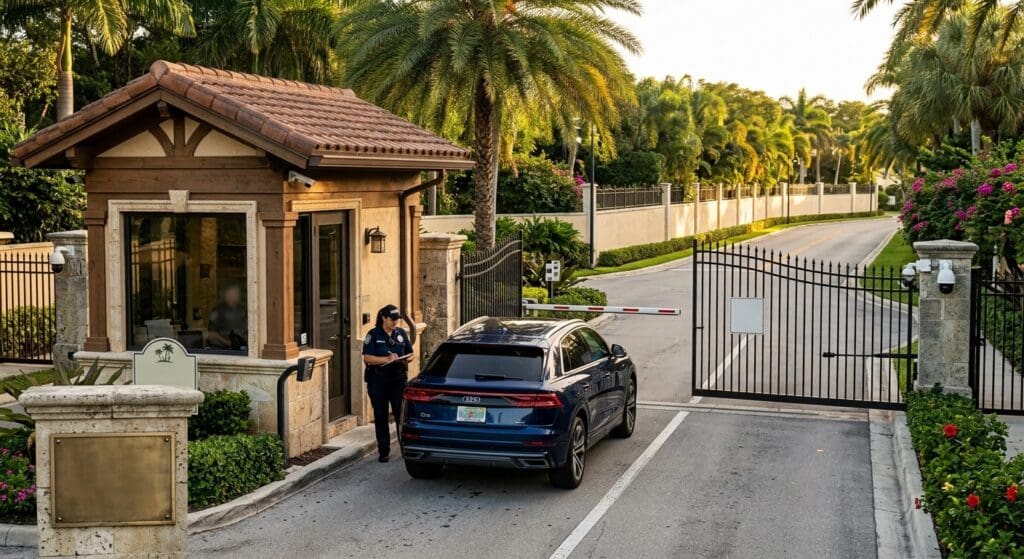
The gate arm had been broken for almost three weeks when the break-in happened. I was on the board, and I had seen the maintenance request sit in the queue behind a landscaping dispute and a pool-heater bill. Then someone followed a resident’s car through the open entrance one night and burglarized two homes, and suddenly the broken gate was the only thing anyone at the next meeting wanted to talk about. A resident stood up and asked why we advertised ourselves as a secure, gated community if the gate did not work and nobody was watching it. I did not have an answer. What I learned in the months that followed is that calling your community “secure” is not just marketing. In Florida, it is a promise that carries legal weight, and a board that does not understand that is exposed in ways it never sees coming.
If you sit on an HOA board or manage a gated community security Miami, this guide covers what real community security involves, the liability most boards overlook, and how to choose a provider that protects both your residents and your association.
What Gated Community Security Actually Involves
Effective community security is more than a gate and a sign. It is a coordinated system of controlled entry and active presence that works together to keep unauthorized people out and residents safe. Understanding the pieces helps a board know what it is actually paying for.
Here’s what the work breaks down into:
Access control and gate guard services
The gate is the front line, and controlling who passes through it is the core of community security. Professional gate guard services verify residents by tag, fob, or barcode, confirm and log visitors, direct deliveries and contractors, and prevent tailgating, where an unauthorized vehicle slips through behind an approved one. A staffed gatehouse also creates a record of who entered and when, which matters both for daily accountability and for any later investigation. A visible, uniformed presence at the entrance sends a clear signal that the community is watched, which deters opportunistic intruders before they ever reach a home.
Patrols and incident response
Access control stops at the gate, but a community’s risk does not. Gated community patrol services extend protection across the interior, with officers moving through roads, parking areas, clubhouses, pools, and other common spaces on foot or by vehicle. Randomized patrol routes deter trespassers, catch problems like propped gates or suspicious activity, and put a trained responder close by when an incident occurs. When something does happen, officers respond, take control of the situation, and document it in a written report. That combination of visible deterrence and real response is what turns a gated perimeter into genuine security.
The Liability Most HOA Boards Overlook
Boards tend to treat security as a line item and a resident-satisfaction issue. In Florida it is also a legal exposure, and it is the part of the decision that carries the highest stakes. Getting this wrong can cost a community far more than any security contract.
Here’s the liability picture every board should understand:
Marketing a community as “secure” raises the duty of care
Under Florida premises liability law, a property owner or operator owes a duty of reasonable care to protect people from foreseeable criminal harm, and that duty extends to HOAs and the gated communities they govern. When a community markets itself on security and residents pay assessments that fund guardhouses, gates, and patrols, the association has represented that protection exists. Courts assess these negligent security claims largely through foreseeability, meaning whether similar crimes had occurred in or around the community. A history of incidents, or ignored warnings like a broken gate, makes harm foreseeable and a failure to act far harder to defend.
The HOA cannot pass liability to its security vendor
Many boards assume that hiring a security company transfers the risk to that company. Florida law does not work that way. An association’s attempt to avoid liability to a crime victim by pointing the finger at its contracted security provider will generally fail, because the duty of care to residents rests with the association itself. Hiring a competent, licensed security partner does not erase the board’s responsibility, but it is the board’s strongest protection, because a provider who delivers documented, adequate security is direct evidence that the association met its duty. The wrong provider leaves the board exposed on both fronts.
What to Look for in a Miami Security Provider
Because the association’s liability rides partly on the quality of its security, choosing a provider is a decision that deserves real scrutiny rather than a comparison of hourly rates. A few specific things separate a provider that protects your community from one that simply staffs a gate.
Here’s what a board should verify before signing:
Licensing and officer credentials
Florida licenses security companies and officers, and a board should confirm those credentials before hiring anyone. The agency must hold a Class B security agency license, and its officers must hold a Class D license if unarmed or an additional Class G license if armed. Ask for the license numbers and verify them with the state. Whether your community needs armed or unarmed coverage depends on its risk profile, and understanding the choice between armed and unarmed officers helps a board match the credential to the actual need rather than overpaying or underprotecting.
Documentation, reporting, and consistency
The paperwork a provider produces is not busywork, it is the record that protects your community. Look for a provider who delivers written incident reports, maintains time-stamped guard and patrol logs, and gives you a single point of contact instead of a call center. Those records demonstrate that the community took its security seriously, which matters directly in any foreseeability analysis. Consistency matters too, since officers who know your community’s rules and enforce them the same way every day build both real security and resident trust. A provider who cannot show you their reporting process is one to pass on.
Balancing Security With Resident Experience
The best community security protects residents without making them feel policed. A gated community is still a home, and officers who treat it like a checkpoint create as many problems as they solve. Striking that balance is part of the job.
Here’s how good providers manage it:
Professional presence without a fortress feel
Effective community officers combine vigilance with courtesy, greeting residents and guests warmly while staying alert to anything out of place. They enforce HOA rules like parking, pool hours, and guest policies firmly but professionally, representing the board consistently without becoming a source of friction. The goal is a presence that reassures residents and deters intruders at the same time, which takes officers trained in customer service as much as security. A guard who is respectful and familiar becomes part of the community rather than an imposition on it.
Privacy and Chapter 720 considerations
Community security generates sensitive information, and Florida law treats some of it as confidential. Under Chapter 720, the records an association keeps about guests visiting residents in a gated community are not accessible to other members, so guest logs and visitor data have to be handled carefully. A professional provider understands these obligations and keeps resident and guest information secure. Handling that data correctly protects residents’ privacy and keeps the association compliant, which is one more reason experience with Florida HOA communities matters when choosing a partner.
Building the Right Security Plan for Your Community
No two communities carry the same risk, so the right security plan starts with understanding your own. A thoughtful assessment produces coverage sized to your community rather than a generic package that costs too much or protects too little.
Here’s how to build it:
Start with a risk assessment
Begin by looking honestly at your community’s risk. Review its crime history and the surrounding area, map every entry point including pedestrian gates and service access, and consider the amenities, common areas, and hours that need coverage. That assessment tells you where you are exposed and what level of security actually fits, whether that is a staffed gatehouse, roving patrols, or a combination. Building from a real evaluation rather than a competitor’s brochure ensures the board spends its security budget where it genuinely reduces risk.
Working with a Miami-experienced HOA security partner
Gated communities have needs that general security does not cover, from visitor management to Chapter 720 privacy rules to the liability dynamics unique to associations, so experience with Miami HOA communities matters. A local partner who knows the area’s risks and the specific challenges of community security can build a plan that fits your community and documents itself properly. Almond Tree Security Services provides residential and HOA security services across Miami-Dade, Broward, and Monroe County, with licensed officers who understand both the safety and the liability sides of protecting a community.
Protect Your Community and Your Board
Gated community security in Miami is about more than a working gate. It is about giving residents genuine safety while protecting the association from a liability most boards never see until it is too late. The communities that get this right start with an honest assessment, hire a licensed and experienced provider, and keep the records that prove they took security seriously.
At Almond Tree Security Services we protect residential and HOA communities across Miami-Dade, Broward, and Monroe County with licensed officers trained in both access control and the realities of Florida community security. If you want a clear read on where your community stands, reach out whenever you like. No pressure either way.
Frequently Asked Questions
Is an HOA responsible for security in a gated community?
Yes. Under Florida premises liability law, an HOA that operates a gated community owes residents and guests a duty of reasonable care to protect against foreseeable criminal harm. When a community markets itself as secure and funds security through assessments, it has represented that protection exists, and inadequate security can create liability.
What does a gate guard do?
A gate guard controls entry to the community by verifying residents, confirming and logging visitors, directing deliveries and contractors, and preventing unauthorized vehicles from tailgating through the gate. The guard also creates a record of who entered and when, and provides a visible deterrent presence at the community’s main point of access.
Can a gated community be liable if a resident is harmed?
Yes, if the harm was foreseeable and the association failed to provide reasonable security. Florida courts weigh prior crimes in and around the community and whether known problems, like a broken gate, went unaddressed. An HOA generally cannot escape liability by blaming its contracted security company, since the duty rests with the association.
How much does gated community security cost in Miami?
Cost depends on the coverage the community needs, including whether it uses a staffed gatehouse, roving patrols, or both, the number of hours, and whether officers are armed or unarmed. Rather than choosing on price alone, base the decision on a risk assessment of your community’s actual exposure.
At Almond Tree Security Services, an unarmed (Class D) officer costs $32 per hour and an armed (Class G) officer costs $40 per hour, with a six-hour minimum. A patrol vehicle is billed separately: $10 per hour when stationary and $14 per hour when running or on patrol. Our South Florida security guard pricing guide explains what changes the total.
What is the difference between a gate guard and a patrol officer?
A gate guard is stationed at the entrance, controlling and logging who enters the community. A patrol officer moves through the interior, covering roads, common areas, and amenities to deter and respond to problems beyond the gate. Many communities use both so that protection extends past the perimeter to the whole property. Neither can make a traffic stop, as we explain in can HOA security pull you over.