
Fire watch is required in Broward County under the Florida Fire Prevention Code as amended by the Broward County Board of Rules and Appeals, whose local fire amendments apply countywide in both incorporated and unincorporated areas. The commonly applied thresholds are more than 4 cumulative hours of fire alarm impairment, or more than 10 cumulative hours of sprinkler impairment, in any 24-hour period.
Your local fire official can order the watch to begin immediately regardless of those numbers.
Who enforces fire watch requirements in Broward County?
Your city’s fire department enforces it, but not from its own rulebook alone.
Broward runs a structure most fire watch articles skip entirely. The Board of Rules and Appeals, known as BORA, publishes the Broward County Local Amendments to the Florida Fire Prevention Code. Those amendments state their own scope plainly: they apply countywide, in both incorporated and unincorporated areas of Broward County.
So there is a shared county layer sitting above every municipality.
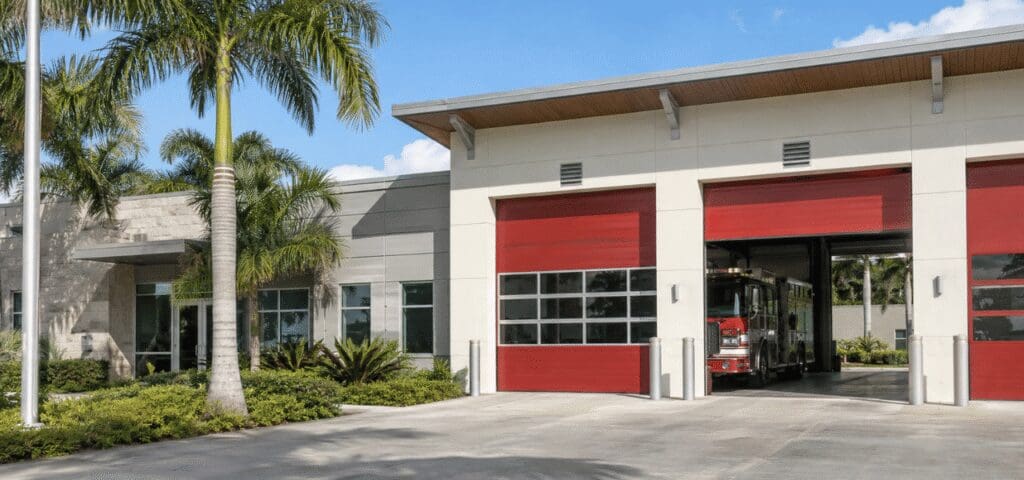
Enforcement still happens locally. Each fire service provider runs its own Fire Prevention Bureau, and that bureau is your Authority Having Jurisdiction. Fort Lauderdale, Hollywood, Pompano Beach, Coral Springs, Davie and North Lauderdale all operate their own bureaus.
Broward Sheriff Fire Rescue covers most unincorporated areas plus Cooper City, Dania Beach, Deerfield Beach, Hallandale Beach, Hillsboro Beach, Lauderdale Lakes, Pembroke Park, West Park and Weston under contract.
Worth knowing if you manage property here: in April 2026 Broward County commissioners voted to study moving Fire Rescue back under county control after more than two decades with BSO. Nothing has changed operationally, but if your building sits in a contracted municipality, confirm who your fire official is rather than assuming.
One more Broward-specific detail. Under the county amendments a Fire Marshal or Fire Code Official cannot simply be appointed. They must hold a BORA certification on top of state firefighter and fire inspector credentials, BORA maintains its own Chief Fire Prevention Code Compliance Officer, and a separate Broward County Fire Code Committee reviews proposed changes.
The practical consequence: when your fire official tells you something, they are applying a documented countywide amendment set, not improvising. Ask which section they are citing. They will have one.
How Broward County differs from Miami-Dade
The two counties reach the same answer through different structures, which matters if you manage property in both.
| Broward County | Miami-Dade County | |
|---|---|---|
| Code layer above the state code | BORA local amendments, applied countywide | Amendments vary by jurisdiction |
| Where those amendments apply | Incorporated and unincorporated areas alike | Depends which city you are in |
| Who your AHJ is | Your municipal fire department, or BSO Fire Rescue | Miami-Dade Fire Rescue, or your city’s own bureau |
| Certification of fire officials | BORA certification required | State certification |
| Appeals and code interpretation | BORA hears appeals and issues formal interpretations | Handled at the enforcing jurisdiction |
In Miami-Dade the first question is which side of a city line your building sits on, and our guide to fire watch requirements in Miami-Dade covers that split in full.
In Broward the first question is which fire department covers your address, because the county amendment layer is already the same for everyone.
When does the fire watch have to start?
Two answers exist, and the distance between them is where most citations come from.
The code threshold
NFPA 25 Section 15.5.2 governs water-based systems and calls for a fire watch once a sprinkler system has been out of service for more than ten cumulative hours in a 24-hour period.
Cumulative is doing real work in that sentence. Six hours of downtime in the morning plus five in the evening is eleven hours, and the threshold is crossed, even though the system was never off for ten hours straight.
Fire alarms fall under NFPA 72, which sets a tighter bar at four cumulative hours in a 24-hour window. NFPA 72 also expects the AHJ to be notified when an alarm system will be inoperable beyond eight hours. Both standards reach Broward through the Florida Fire Prevention Code, adopted by the State Fire Marshal.
What your fire official will actually say
Treat the hours as a floor, not a grace period.
An AHJ can require a watch from hour zero, and across South Florida many read “immediately” literally when a sprinkler system goes down in a hotel, a condo tower or a hospital. Broward has a dense stock of exactly those properties, from the beachfront high-rises through Fort Lauderdale and Hollywood to the assisted living facilities inland.
Starting the watch early costs a few hours of officer time. Starting late can cost an occupancy restriction, a disputed insurance claim, or a citation that stays attached to the property.
How often does the guard have to patrol?
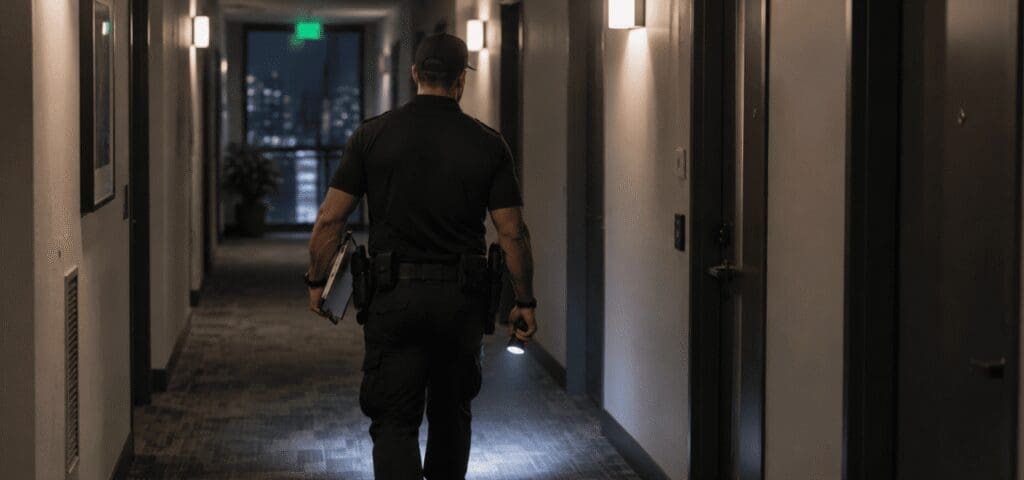
Your AHJ sets the interval, and there is no single number in state code.
The benchmark most Florida jurisdictions work from is published by Palm Beach County Fire Rescue: every 15 minutes for residential and assembly occupancies, every 30 minutes for all other occupancy types.
Applied to typical Broward properties:
- Condos, apartments, hotels, restaurants, theaters, houses of worship — expect 15-minute rounds
- Offices, warehouses, retail, light industrial — expect 30-minute rounds
- High-rises and large assembly occupancies — often more than one officer per shift, with divided routes
Confirm the interval when you notify your fire official, and get the answer in writing. An email is enough. It is the document that settles arguments later.
For properties that need timed, documented rounds on an ongoing basis rather than during an emergency, security patrol services run on the same principle with verified checkpoints.
What your Broward fire inspector will ask to see
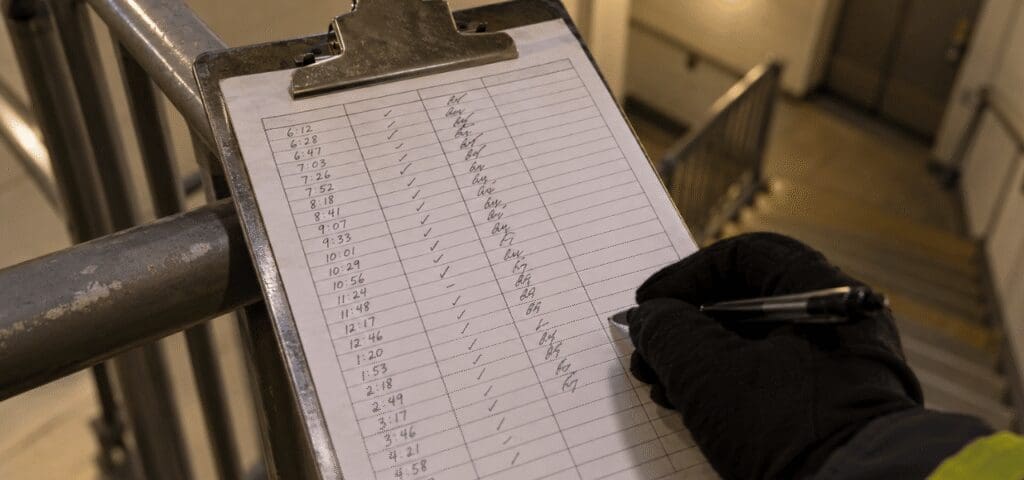
The log. Almost every fire watch dispute reduces to that one document.
A defensible log records, for every round: the date and clock time the round started, the route or areas covered, the name and signature of the officer who walked it, observations including “no hazards observed” as a positive finding rather than a blank, and any incident, alarm activation or 911 call with times.
Two failures come up repeatedly.
The first is a log that begins hours after the impairment did, which tells the inspector the building sat unprotected. The second is a log with entries at exactly :00 and :30 in identical handwriting, which reads as filled in afterwards rather than actually walked.
Your insurance carrier will want the same document, and so will your board if a claim is ever filed.
Your first hour: what to do right now
If a system is down at this moment, work in this order.
- Identify your AHJ. Your municipal fire department’s Fire Prevention Bureau, or BSO Fire Rescue if your city contracts with them.
- Notify them and your insurance carrier. Write down the time of both calls.
- Name an impairment coordinator. NFPA 25 expects a specific person to be responsible. Put the name in writing.
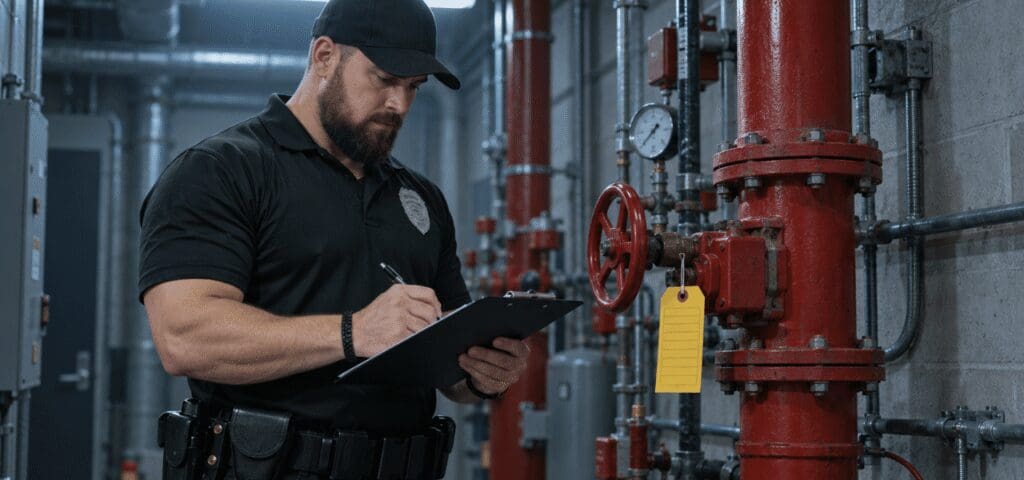
- Tag the system at the control valve and the fire department connection so it is visibly out of service.
- Start the watch. Do not wait for the threshold.
- Confirm the patrol interval and the stand-down conditions with your AHJ, by email where possible.
- Keep the watch running until the system is restored, tested, and the AHJ releases you. Restoration and release are not the same event.
When you may not need to hire a fire watch company
Sometimes your own staff can stand the watch, and it is worth knowing that before you call anyone.
If your AHJ approves it, an employee can perform the watch provided they are dedicated solely to that task, trained on the route and the log, and available for the entire impairment. A short daytime outage in a small office with a maintenance person already on site is a realistic case for this.
Where it falls apart is duration and coverage. A watch that runs overnight, across a weekend, or through a multi-building property needs relief shifts and consistent documentation. Most buildings cannot pull someone off their actual job for 48 hours, and a log with gaps in it is what fails inspection.
An officer already working the site as a security guard also cannot double as the fire watch. The watch is a dedicated post, and a fire official who discovers otherwise can treat the property as having had no compliant coverage at all.
Fire watch coverage in Broward County
Almond Tree Security Services is a Homestead-based Florida-licensed security agency holding Security Agency License B 3500420 and Private Investigation Agency License A 3500419, serving Broward, Miami-Dade and Monroe counties.
We respond to every fire watch request within 2 hours and have licensed officers on site within 4, 24 hours a day, including nights, weekends and holidays. Every officer holds a Florida Class D license and completes 40 hours of field training, and the officers assigned to fire watch are trained on documentation before anything else.
Emergency dispatch: (305) 216-1818 · Office: (786) 368-9905
See the full fire watch service details or request a quote.
Frequently asked questions
Who is my AHJ for fire watch in Broward County?
Your municipal fire department’s Fire Prevention Bureau, or Broward Sheriff Fire Rescue if your city contracts with them. All of them apply the Broward County Local Amendments to the Florida Fire Prevention Code, published by BORA, which cover incorporated and unincorporated areas alike.
How much does a fire watch cost in Broward County?
Published 2026 industry guides put scheduled fire watch at $30 to $55 per hour per guard, and emergency same-day coverage at $50 to $150 per hour, with a minimum shift of four to eight hours. Multi-day impairments are normally quoted at a lower blended rate than a single overnight call-out.
How fast can a fire watch guard reach my building in Broward?
Almond Tree responds to every request within 2 hours and has a licensed officer on site within 4, including nights and weekends. Across the industry, same-day dispatch usually carries a premium of 25 to 50 percent over a scheduled rate, so calling as the impairment starts costs less than waiting for the threshold.
Does a fire watch guard in Florida need a special license?
Florida does not issue a fire watch license. The work is performed by security officers licensed under Florida Chapter 493, Class D for unarmed posts and Class G where an armed officer is required, trained specifically in fire watch patrol procedure and log documentation.
Are Broward’s fire watch rules different from Miami-Dade’s?
The NFPA thresholds are the same, because both counties enforce the Florida Fire Prevention Code. The difference is structural. Broward has a countywide amendment set published by BORA that applies everywhere in the county, while Miami-Dade’s requirements vary more by which jurisdiction covers your address.
How long do I have to keep the fire watch running?
Until the impaired system is fully restored and tested, or until your AHJ formally releases you, whichever comes later. The repair crew leaving is not the end of the watch. Ask your fire official directly what conditions release you, and keep the log running until they are met.