
Eleven days before our fundraiser, I opened an email from the police department and read it four times before it registered. Our permit had not been cleared. I had already locked the venue, confirmed the caterer, and printed 900 wristbands, and I had hired six guards from a company a colleague recommended over coffee. The reviewing officer listed two problems. Our headcount pushed us into a bracket that required sworn off duty officers in addition to private guards, and the company I hired never produced an agency license number. I spent that week on the phone instead of on the run of the show. We opened on time, barely, and I paid close to forty percent more than I had budgeted. Nobody warned me that a police department, not me, writes the final version of an event security plan.
If you are staring at a permit review, a vague security quote, or an insurance deadline you did not see coming, this blog post covers exactly that.
Your Security Plan Isn’t Really Yours: The Permit Desk Has Final Say
Most organizers treat event security as a vendor decision. In South Florida it works as a regulatory decision, because a police reviewer reads your plan and holds the authority to change it or reject it outright.
Here’s how that authority actually works:
The reviewing agency sets the minimum, not your vendor
North Miami Beach states the arrangement plainly. Once you submit a security plan, the police department reviews it, recommends the minimum number of licensed private guards and off duty officers your event needs, and holds final authority over that number. Fort Lauderdale takes the same position, and its application makes organizers acknowledge that the police department will determine all security requirements. Your vendor quote functions as a proposal, and the reviewer approves, expands, or rejects it.
They can stop the event and send you the bill
North Miami Beach reserves the right to shut down any or all components of an event when the guard count proves inadequate, bring in additional police services, and bill the host organization directly for that cost. Almost nobody budgets for a mid event staffing correction at police rates. Build your guard count to survive a skeptical read rather than to hit a target price.
The Officer Ratios South Florida Jurisdictions Actually Use
Competing guides tell organizers that staffing “depends on the event.” South Florida agencies publish far more specific figures than that, and knowing them lets you build a credible plan on the first submission.
Here are the numbers reviewers work from:
Miami-Dade County’s published guidelines
Miami-Dade’s parks special events permit guidance describes one off duty police officer for every 200 people, one sergeant for every five officers, and one lieutenant for every three sergeants. Traffic and parking staffing follows a separate scale, with a minimum ten person team plus a supervisor for Class A events and a minimum five person team plus a supervisor for Class B or Class C events. The county reviews each event case by case, so treat these as your starting bracket rather than a statewide rule.
The municipal triggers that catch organizers off guard
South Miami requires off duty officers for street closures, alcohol sales, or crowds over 50 people, and the applicant pays those officers before the event. A block party crosses that line faster than most planners expect. Miami Beach applies its own supervision rule and generally requires a sergeant or above once four or more officers work a detail. Call the special events office in your specific city, because county figures and city figures often differ.
Off-Duty Police vs. Licensed Security Officers: You Likely Need Both
Organizers routinely budget for one category and then discover the permit requires both. The two roles carry different legal authority, different costs, and different jobs on your site map.
Here’s what separates them:
What sworn officers do that licensed guards cannot
Sworn off duty officers carry arrest authority, issue citations, direct traffic in the public right of way, and coordinate directly with responding units over police radio. Cities lean on them for street closures, intersection control, and anything likely to end in a report or a prosecution. Hiring them individually turns you into the employer, and most agencies require officers to secure departmental approval before working the detail.
What licensed officers handle better and cheaper
Licensed Class D officers staff entry lanes, run bag and wristband checks, hold interior and perimeter posts, manage guest flow, handle ejections, and write the incident reports that matter later. They scale to long hours at a fraction of sworn officer rates, and a single agency supplies uniforms, supervision, radios, and post orders under one contract. Professional event security services across South Florida usually map this split during the first site walk.
The Licensing Detail That Can Void Your Coverage
Florida regulates security companies and individual officers under two separate licensing tracks, and one provision inside that framework creates real exposure for the organizer rather than the vendor.
Here’s what you need to verify before hiring anyone:
Class B, Class D, and Class G explained plainly
A business that furnishes security services for compensation holds a Class B security agency license. Each unarmed officer holds a Class D license, and each armed officer holds a Class D plus a Class G firearms license. Ask for all three categories in writing, then verify them yourself through the FDACS Division of Licensing database before you sign anything. A vendor who hesitates at that request has already answered your question.
Why subcontracted guards create your exposure
Under Florida Statute 493.6301, a Class D licensee must own or work as an employee of a Class B agency, and the state officer handbook confirms that Class D licensees may not enter into subcontractor agreements. A freelance guard, a gig app booking, or a body borrowed from another firm falls outside that structure. Chapter 493 also makes it a violation to contract with an improperly licensed agency when reasonable inquiry would have revealed the status.
Insurance and the 30-Day Deadline
Insurance requirements sink more events than staffing shortfalls do, mostly because endorsements take days to issue and deadlines land a full month before doors open.
Here’s what to file and when:
Coverage minimums vary by activity
Miami-Dade’s parks permit requires general public liability between $300,000 and $1 million depending on activities, automobile liability of at least $300,000, and liquor liability whenever the event serves wine or beer. Fort Lauderdale requires state alcohol licenses and $500,000 of liquor liability filed 30 days before the event, plus an endorsement naming the city and its officers, employees, and volunteers as additional insureds. Start the request six weeks out.
Collect your security vendor’s certificate too
Request a certificate of insurance from your security agency, confirm the coverage matches your event size, and confirm the agency carries it rather than the individual guards. Keep both certificates, the approved permit, and the final security plan in one folder. That folder becomes the first thing your attorney asks for if an incident produces a claim.
Three Counties, Three Different Playbooks
The same event runs three different approval processes depending on where you hold it, and the Florida Keys change the operational math entirely.
Here’s how each county behaves:
Miami-Dade
Miami-Dade fragments into more than 30 municipalities, and each police department runs its own review with its own standards. An event in Homestead, an event in Doral, and an event on Miami Beach follow three different processes under one county. Identify the reviewing jurisdiction before you sketch a staffing plan, because unincorporated county rules will not govern a permit inside city limits.
Broward
Fort Lauderdale determines security and emergency service requirements from your application, site plan, narrative, and traffic plan taken together, and much of the supporting paperwork carries a 30 day deadline. Incomplete packages get denied rather than corrected. Pembroke Pines, Hollywood, and Pompano Beach each maintain separate applications, so verify the local process instead of assuming Fort Lauderdale’s rules travel north.
Monroe County and the Florida Keys
One highway connects the entire chain, so a staffing gap in Marathon takes hours to fill from the mainland rather than minutes. The local vendor pool stays thin, peak season stacks events on top of each other, and mutual aid arrives from farther away than planners assume. Book officers early, stage the team on island before doors open, and write a weather contingency, since a bridge slowdown or a squall can strand a shift change.
What Actually Goes Wrong Once Doors Open
Approval clears your paperwork risk. The operational risk starts when guests arrive, and it concentrates in a handful of predictable places.
Here’s where events break down:
Alcohol, re-entry, and unmanned exits
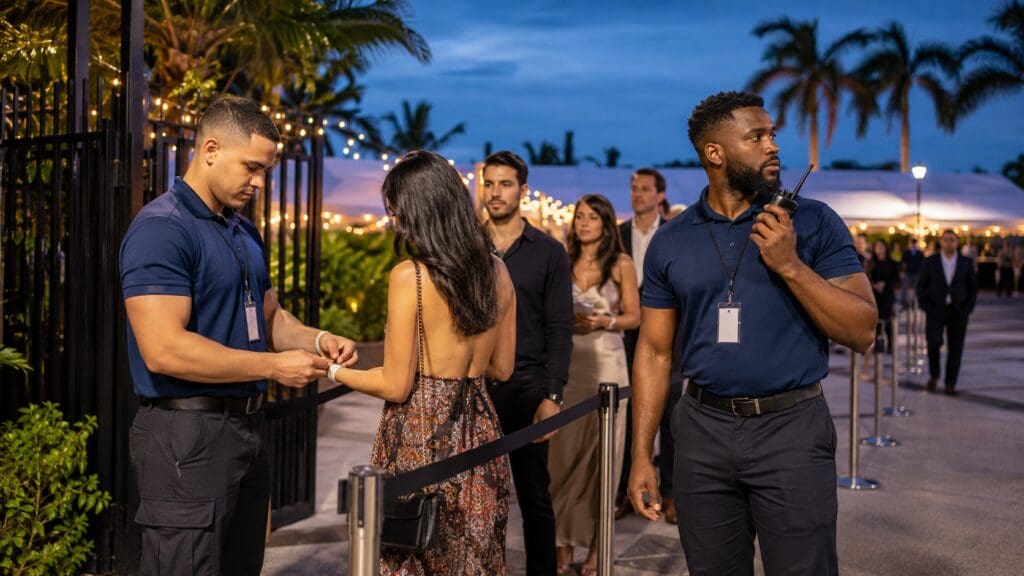
Alcohol drives most ejections at South Florida events, and the trouble usually starts near the bar line rather than at the gate. Re-entry policies fail when wristband checks loosen after the first hour, which lets unticketed guests walk in behind a returning group. Side exits create the third failure, because staff prop them open for load in convenience and then forget them. Post an officer on every door that opens.
Weather holds and load-out
South Florida storms build fast, so write your lightning hold threshold, shelter routing, and announcement script before the event rather than during it. Departure carries similar risk, since a crowd leaving at once collides with vendor load out, rideshare pickups, and street reopening. Keep officers on post through breakdown, run a final sweep, and collect written incident reports from every position.
Why All of This Is Really a Liability Question
Every permit requirement and licensing rule in this article traces back to one question a court will ask later: did the organizer take reasonable steps.
Here’s how those claims work in Florida:
Foreseeability decides these cases
Florida negligent security claims fall under Chapter 768 premises liability, and they turn on whether a reasonable person could have foreseen the criminal act and whether inadequate security contributed to the harm. Courts weigh prior similar incidents at the venue and in the surrounding area heavily. Event organizers face these claims alongside property owners, and contracted security firms sometimes share the liability.
Documentation becomes your defense
An approved permit, a written security plan, verified license numbers, current certificates of insurance, and contemporaneous incident reports all demonstrate diligence. Florida’s modified comparative negligence framework under HB 837 lets a court apportion fault among the criminal actor, the property owner, and the organizer, so that evidence directly affects your exposure. Build the file before the event, not after a demand letter arrives.
Your Pre-Doors Security Checklist
Two windows matter. The first handles paperwork, and the second handles people.
Here’s the timeline that keeps both on track:
60 to 30 days out
Confirm the reviewing jurisdiction and request the special event application. Estimate final headcount, then flag any street closure, alcohol service, or amplified sound. Request quotes from Class B licensed agencies and verify every license number through the state database. Order insurance certificates and additional insured endorsements. Submit your written security plan with the full permit package.
14 days to doors open
Walk the site with your security supervisor and mark every entry, exit, bar, stage, and emergency lane on a post map. Confirm the sworn officer detail and the private officer count in writing. Distribute post orders, radio assignments, and the weather protocol. Hold a briefing on event day before the first guest arrives, and test every radio.
Planning an Event in Florida?
Most of this goes smoothly when you start early and hire an agency that has already sat on the other side of a permit review. Almond Tree Security Services operates from Homestead under Florida Security Agency License B# 3500420, staffs every assignment with Class D and Class G licensed officers, and covers Miami-Dade, Broward, and Monroe County around the clock. We respond within two hours and deploy within four, which helps when a reviewer raises your guard count late.
If you want a second opinion on a staffing plan or a walkthrough of your venue, reach out to Almond Tree Security Services and we will talk it through. No pressure either way, and the site walk costs nothing.
Frequently Asked Questions
How many security guards does an event in South Florida need?
The reviewing police department sets the final number after examining your permit application. Miami-Dade’s published parks guidance uses roughly one off duty officer per 200 attendees as a starting bracket, with supervisory officers layered above that. Alcohol service, street closures, ticketing, and late hours all push the count higher.
Does Florida law require licensed security guards at events?
Florida requires anyone performing security officer services to hold a Class D license, and the employing company to hold a Class B agency license. Armed officers additionally hold a Class G license. Many municipalities also require a written security plan as part of the special event permit.
Can I hire freelance or independent security guards for my event?
No. Florida law requires a Class D licensee to own or work as an employee of a Class B security agency, and Class D licensees cannot enter subcontractor agreements. Contracting with an improperly licensed provider creates legal exposure for the organizer as well as the vendor.
What is the difference between off duty police officers and private security guards?
Sworn off duty officers carry arrest authority, issue citations, and direct traffic on public roads. Licensed private officers handle access control, bag checks, crowd flow, interior posts, ejections, and incident documentation at lower cost. Most South Florida events staff both categories side by side.
How far in advance should I book event security?
Start 45 to 60 days out for anything involving a permit, alcohol, or a street closure, since insurance endorsements and permit reviews commonly carry 30 day deadlines. Peak season and Florida Keys events fill faster. Qualified agencies can still deploy on short notice, but options narrow and costs rise.
Who is liable if something happens at my event?
Florida negligent security claims can name the property owner, the venue operator, the event organizer, and the security contractor. Liability turns on foreseeability and on whether reasonable security measures existed. Documented planning, verified licensing, and written incident reports strengthen an organizer’s position considerably.